Start a Project

Chem Film Services

Prototek's Advanced Finishing and Post-Processing Solutions

What is chem film?

Chem film goes by a few different names, such as chemical film, Alodine®, or chromate conversion coating. The main purposes are to enhance the corrosion resistance, maintain electrical conductivity, and improve paint adhesion without altering the part’s dimensions. This particular chemical treatment is primarily applied to aluminum and aluminum alloys.

What is the chemistry and composition of chem film?

  • How does it work? Chem film is a chemical reaction between the metal surface of a part and the chromate-containing solution. It forms a thin, adherent layer of mixed metal oxides and chromates.
  • What types of chem film are there?
    • Type I: Hexavalent chromium, which is a sodium dichromate-based layer.
    • Type II: Trivalent chromium or non-hexavalent, which is environmentally friendly.
    • Note: While traditional coatings, Type I, are iridescent yellow-gold or greenish-gold, the Type II trivalent offers clear versions that are available for RoHS compliance.

What are the industry standards?

  • MIL-DTL-5541: The U.S. military’s specification for chemical conversion coatings on aluminum and its alloys defines Type I and Type II, as well as uses Class 1A for maximum corrosion protection and Class 3 for electrical conductivity.
  • ASTM B449: Additional standard for chromate conversion coatings.
Chem Film Services

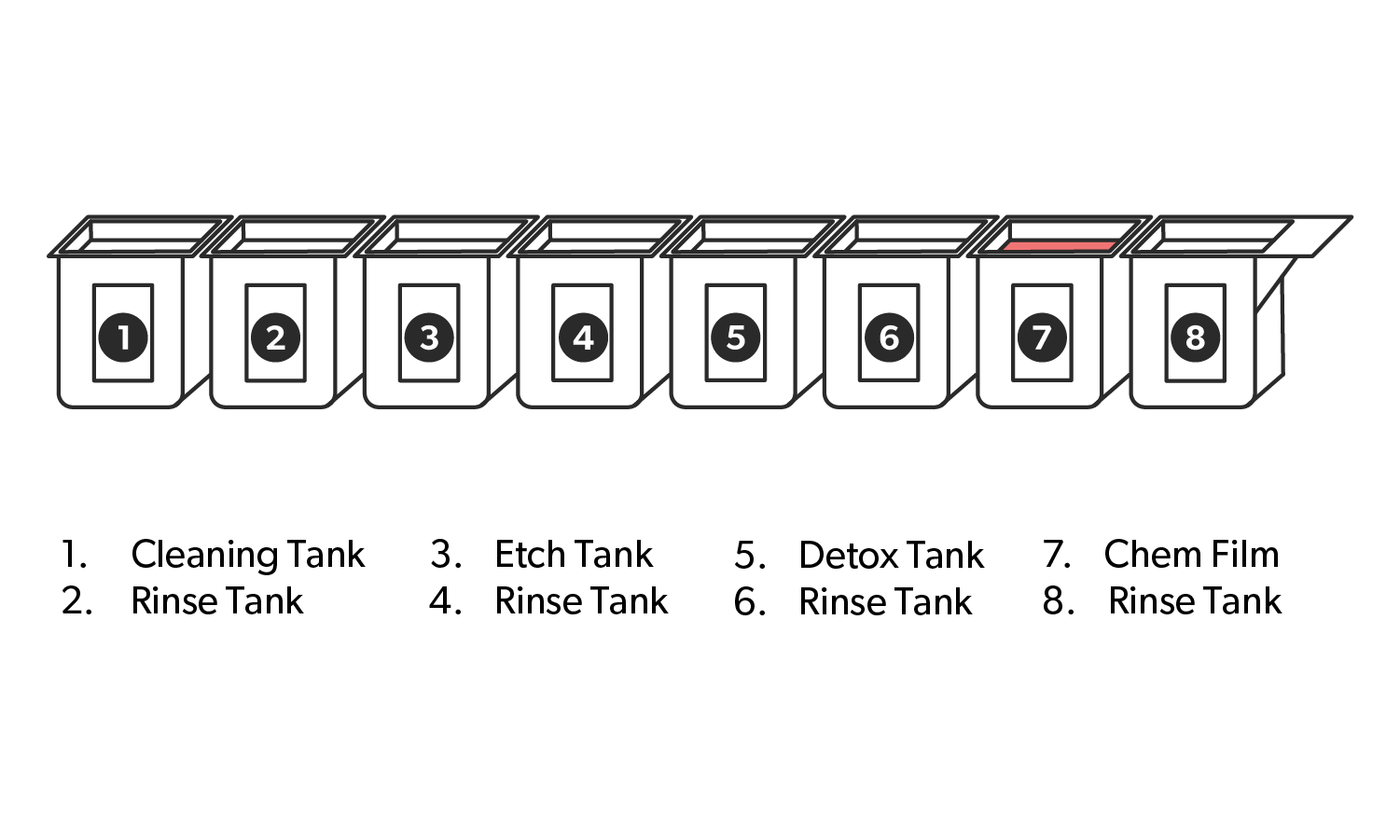
What is the step-by-step process for chem film coatings?

  1. Surface Preparation
    • Cleaning and Degreasing: The removal of oils, grease, and other contaminants using alkaline cleaners or solvents is the first step.
    • Etching: This is an optional step where alkaline or acid etchants remove oxides and create a uniform surface.
  2. Application of the Chemical Conversion Coating
    • Methods:
      • Immersion: This is also known as “dip” and is the most common for uniform coverage on parts.
      • Spray: This method is common for larger or very complex parts.
      • Brush-On or Wipe-On: Common for touch-up or small areas.
      • Note: The processing time is typically 1-5 minutes at room temperature. The surface will develop an iridescent or golden color as the coating forms.
  3. Rinsing:
    • First Rinse: Right away after the coating, the parts are rinsed with deionized or distilled water.
    • Second Rinse: This rinse is optional and is only necessary for critical components.
  4. Drying:
    • Air Drying: Avoiding high temperatures is preferable, making air drying ideal.
    • Oven Drying: If the part requires oven drying, make sure it is specified. It can only be done at low temperatures.
  5. Quality Control and Inspection
    • Visual Inspection: Double-check that the color and coverage are uniform.
    • Adhesion Test: Tape or paint adhesion tests are a requirement for advanced post-processing and finishing.
    • Electrical Resistance: For Class 3, measure the surface resistance.
    • Corrosion Resistance: Using a salt spray or humidity test for critical parts.
  6. Class 1A vs Class 3
    • Class 1A: It offers excellent corrosion resistance. The coating is thicker and stronger. It appears to be darker and more iridescent in appearance. Common applications include aerospace, marine, and use in extreme environments.
    • Class 3: It offers excellent conductivity. The coating is thinner and has lower corrosion resistance. It is lighter and has less color in appearance. Common applications include electrical bonding and grounding.
  7. Post-Treatments
    • Handling: Avoid touching the coated surfaces.
    • Painting and Bonding: Chem film is an excellent primer for paints and adhesives.
    • Storage: Store in dry, clean environments.
Manufacturing Finishing - Chem Film

What are some applications for chem film?

  • Aerospace and Defense: For its corrosion resistance, electrical conductivity, paint adhesion, and MIL spec compliance, the applications in aerospace and defense include aircraft parts, missiles, other weapons, communication devices, and military vehicles.
  • Electronics and Electrical: For its corrosion resistance, paint adhesion, and specification compliance, the electronic and electrical applications include chassis, fasteners, and connectors.
  • Automotive: For its corrosion resistance, paint adhesion, and high-volume processing, the automotive applications include panels, engines, and fasteners.
  • Marine: For its corrosion resistance and hydrophilicity, the marine applications include hulls, hardware, and exchangers.

What are some of the advantages of using chem film?

  • Corrosion Resistance: Chem film forms a passive barrier against moisture and contaminants, which extends the component’s life.
  • Electrical Conductivity: Maintains a low resistance, which is excellent for grounding and EMI shielding.
  • No Dimensional Change: The coating is ultra-thin, so tight tolerances and fits are preserved.
  • Cost-Effective: The simple, single-step process with quicker turnaround times, and it offers lower costs than anodizing.
  • Paint and Adhesive Base: Provide a great foundation for durable finishes.
  • Spec Compliance: Meets MIL-DTL-5541, MIL-DTL-81706, and ASTM B449 for both aerospace and defense.
  • Environmental: Type II, trivalent chem film, is RoHS-compliant and safer for both workers and the environment.
Chem Film Services
Ready to get your project started?
