The drone industry has a problem. Fortunately, it’s the kind of problem most industries would love to have.
Somewhere between 17 and 18 million drones will be built this year, representing nearly a billion individual components across airframes, propulsion systems, electronics, payloads, and structural hardware. Demand continues to grow across defense, industrial inspection, agriculture, infrastructure, and public safety. At the same time, customers want aircraft tailored to increasingly specialized missions, and they want them faster than ever. Designs evolve constantly as new sensors, payloads, and communication systems come online.
Designing a good drone is no longer the hard part.
Building enough of them without slowing innovation has become the bottleneck.
That’s exactly where additive manufacturing fits.
Not because every drone should be 3D printed. It shouldn’t. But because additive manufacturing gives engineering teams another option when conventional manufacturing starts getting in the way.
The Math on Tooling Stops Working
Injection molding is an incredible manufacturing process. If you’re building hundreds of thousands of identical parts, it’s difficult to beat.
Most drone programs never look like that.
A platform that’s current today might receive a new payload in six months. A redesigned sensor package changes the mounting geometry. Flight testing uncovers an opportunity to shave weight from a bracket. Before long, the design has evolved again.
Nobody wants to cut expensive tooling for a part that’s likely to change before the mold has paid for itself.
That’s where additive manufacturing changes the economics.
Instead of waiting on tooling, engineering teams can revise the CAD model, produce another iteration, test it, and keep moving. We’ve seen programs work through several meaningful design revisions before tooling for the original concept would have even arrived.
That flexibility is especially valuable in the middle of the production curve, where quantities are too high to machine every component individually but too low to justify dedicated tooling for every revision. That’s where a surprising number of drone programs actually live.
What Actually Gets Printed?
Forget prototyping.
Industrial additive manufacturing is producing flight-ready hardware across today’s drone platforms.
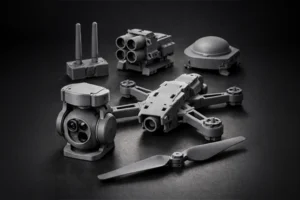
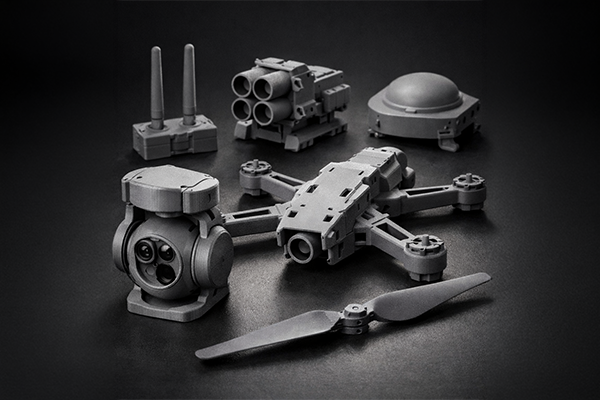
Airframe sections, winglets, sensor mounts, camera housings, cooling ducts, ESC covers, antenna radomes, structural brackets, RF hardware, motor mounts, and heat sinks are all common applications.
Some of the smartest designs don’t rely on additive manufacturing alone. They combine printed components with off-the-shelf carbon fiber tubes, precision-machined interfaces, or sheet metal parts. Carbon fiber carries the structural loads. Printed components handle the complex geometry. Machined parts provide the precision where it’s needed.
Each process does what it does best.
That’s a conversation we have with customers all the time. The question usually isn’t, “Can this be printed?”
It’s, “What manufacturing process gives this part the best combination of performance, lead time, cost, and long-term scalability?”
Sometimes the answer is additive manufacturing.
Sometimes it isn’t.
That’s exactly how the decision should be made.
Metal additive manufacturing creates another opportunity through part consolidation. Components that once required several machined pieces and multiple fasteners can often become a single printed part. Fewer components mean fewer assembly operations, fewer potential failure points, and a simpler bill of materials.
Every Gram Matters
Ask almost any drone engineer where they want to save weight.
The answer is usually everywhere.
Every gram removed from an aircraft comes back as additional flight time, payload capacity, or range. That’s why additive manufacturing has become such a valuable engineering tool.
Once manufacturing constraints are reduced, engineers can optimize around performance instead of process limitations. Internal lattice structures, topology optimization, and other Design for Additive Manufacturing (DfAM) techniques allow material to be placed exactly where it’s needed and nowhere else.
Those opportunities don’t happen automatically.
Choosing the right additive technology, material, orientation, and finishing process requires engineering judgment. That’s where collaboration early in the design process often delivers the biggest return.
Defense Manufacturing Raises the Stakes
For defense UAS programs, manufacturing decisions go well beyond geometry and lead time.
Security, traceability, quality systems, and domestic manufacturing capability have become part of the supplier evaluation process.
Anyone can manufacture a drone component.
Producing it in a U.S. facility that is ITAR Registered, AS9100D and ISO 9001:2015 Certified, and CMMC Level 2 C3PAO Certificated is a different conversation entirely.
For defense contractors, those qualifications help reduce supply chain risk while supporting secure manufacturing of controlled technologies.
At Prototek, additive manufacturing doesn’t exist in isolation. Our customers regularly combine industrial additive manufacturing with CNC machining, sheet metal fabrication, finishing, inspection, and assembly as programs move from prototype into production.
That means the same engineering team that helps determine whether a bracket should be printed today can help decide when that same component should transition to machining, sheet metal fabrication, or another manufacturing process tomorrow.
That’s often where the biggest long-term value comes from.
Stop Asking "Additive or Traditional?"
One of the most common questions we hear is whether additive manufacturing is replacing conventional manufacturing.
The better question is which process best fits the application.
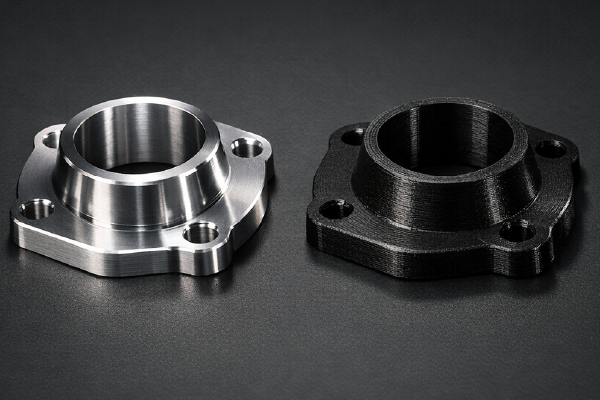
Complex, lightweight geometries may be ideal for additive manufacturing. Precision interfaces may belong on a CNC machining center. Sheet metal fabrication may be the fastest and most economical option for another component. As production volumes stabilize, injection molding may become the logical next step.
The best drone programs aren’t committed to one manufacturing technology. They’re committed to making good engineering decisions.
That’s why integrated manufacturing matters. When engineering teams have access to multiple manufacturing technologies and the expertise to choose between them objectively, they gain flexibility throughout the product lifecycle instead of locking themselves into a single approach too early.
And that’s ultimately what additive manufacturing is really about. Not replacing traditional manufacturing, but giving engineers another powerful tool for solving complex manufacturing challenges.
FAQs
When is additive manufacturing the right choice for drone components?
Additive manufacturing is often a strong fit for lightweight, complex, low-to-medium volume parts, especially when designs are expected to evolve during development.
Can additive manufacturing produce production-ready drone parts?
Yes. Industrial additive manufacturing is routinely used for end-use polymer and metal components across commercial, aerospace, and defense UAS applications.
Is additive manufacturing replacing CNC machining?
No. The most successful drone programs typically combine additive manufacturing, CNC machining, sheet metal fabrication, and other manufacturing processes.
Why does integrated manufacturing matter?
Working with a manufacturing partner that offers multiple production technologies makes it easier to choose the right process for each component as designs evolve.
Ready to Build Your Next UAS Program?
Whether you’re developing a functional prototype, preparing for flight qualification, or scaling production, Prototek’s engineering team can help determine the right manufacturing process for every component.