Cast urethane has become a go-to process for medical device engineers seeking prototyping and low- to medium-volume production. We work with a few companies that value the wide range of medical applications cast urethane can deliver. From prosthetics to implantable devices and medical device enclosures.
In this blog post we’ll discuss best practices and design tips for using cast urethane for medical devices.
Understanding The Cast Urethane Process
Cast urethane creates components by pouring liquid polyurethane into flexible silicone molds. Prototek offers a variety of molds, and we can print master patterns via our stereolithography Quickcast® method. Meaning we can be with you through the whole process – every step of the way.
Cast urethane components resemble injection-molded parts and are an excellent choice for prototyping and low-to-medium-volume production runs. With this process, we can easily bridge the gap between prototyping and production for our customers.
We use a vacuum chamber to remove air bubbles for clarity and to achieve the desired hardness and color with a precise mixture of the two-part resins.
What are the steps for the cast urethane process?
- Master Pattern: A high-resolution 3D print, often a stereolithography Quickcast®, serves as the master pattern. Prototek can capture the final part’s details and surface finish with these high-resolution prints.
- Mold: The master pattern is enclosed in liquid silicone, which cures to form a flexible mold that is cut in half for easy part removal. A second option is 3D printing the inverse of the part, creating a hard mold for softer end-use parts.
- Preparing the Urethane: Two liquid urethane resins are mixed precisely with additives and pigments, if needed, to initiate a chemical reaction.
- Pour and Cure: Next, the mixed resin is poured into the mold and placed in a vacuum chamber to eliminate air bubbles.
- Demolding and Finishing: Lastly, the urethane component is removed, trimmed of sprues/vents, and finished to spec.
Understanding Cast Urethane Materials
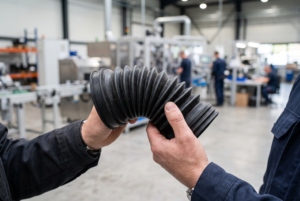
From rubbery materials used for grips and training models to rigid plastics used for housing, there are many options available for cast urethane in the medical industry. Types of materials include polyether, polyester, and polycarbonate-based urethanes.
Due to the two-resin urethane casting process, some properties are controllable by our technicians, while others are inherent to the material.
- Soft and Flexible (Shore A): Applications include: grips, seals, gaskets, soft-touch components, and training models.
- Rigid and Tough (Shore D): Applications include: housings, enclosures, and durable components.
- Biocompatibility: Non-cytotoxic and low immunogenicity.
- Chemical Resistance: Resistant to bodily fluids and chemicals.
- Hemocompatibility: Suitable for blood-contacting devices.
- Specialty Materials: MRI-transparent, flame-retardant, and UV-resistant.
Design Guidelines and Best Practices
Dimensional Tolerances
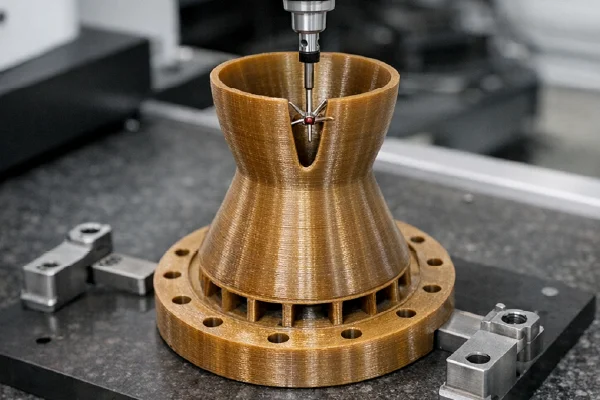
How are tolerances determined in cast urethane? Tolerances depend on the quality of the 3D-printed or CNC-machined master. Prototek commonly uses 3D printing, but we can also create the master via CNC.
- Prototek’s SLA Quickcast® Tolerances: ± 0.005 in for the first inch and ± 0.0015 in/in for each additional inch
- Prototek’s CNC Machining Tolerances (Milling): For general tolerances, we adhere to ISO 2768 standards or ± 0.005 inches (± 0.127 mm) for metal parts and ± 0.010 inches ( ± 0.254 mm) for plastic and composite parts.
If tolerances are not included, we use ±0.010 inch or ±0.003 inch per inch, whichever is larger, which is common. A shrinkage rate of + 0.15% is expected due to the liquid’s thermal expansion in the flexible mold.
Wall Thickness
Does wall thickness matter in cast urethane? Prototek recommends a minimum wall thickness of 0.040 in (0.5 mm) and, for best performance, walls should be between 0.060 and 0.16 in (1.5 mm-4mm) thick. For best practice, maintain uniform walls, especially if you plan to move production into injection molding. It is ok in cast urethane to use varying wall thicknesses.
Draft Angles
Do draft angles matter in cast urethane? Draft angles are not necessary in cast urethane, but again, if you plan to move production to injection molding, they should be incorporated into the design. They will be required in injection molding when components need to be removed from hard tooling rather than soft molds.
Ribs
Should ribs be included in your design for cast urethane?Yes, ribs increase a part’s bending stiffness without adding thickness.
Bend Stiffness = E (Young’s Modulus) x I (moment of inertia)
- What rib height makes sense for cast urethane? Prototek recommends that the height of a rib not exceed 3 times its thickness. We also recommend multiple ribs versus one really tall rib for cast urethane.
- What rib width is recommended for cast urethane?At Prototek, we recommend that the rib thickness not exceed 60% of the normal wall thickness.
- Do ribs in cast urethane need fillets? Yes, we recommend fillets for ribs to avoid sink marks. Prototek recommends at least 25% of the part’s thickness.
- Are draft angles important for ribs in cast urethane?Yes, we recommend draft angles for ribs also to mitigate sinking. Draft angles should be between 0.25 and 0.5°. And they should be equal!
- How far apart should ribs be for cast urethane?For consecutive ribs, Prototek recommends spacing them 2x the thickness for maximum impact.
Coring
What is coring, and does it matter for cast urethane parts?Coring means removing material where available. Helping the component remain lightweight reduces the material needed and prevents defects such as sink marks and warping. It also helps maintain wall thickness throughout the entire part.
Radii and Fillets
Are radii and fillets necessary for parts produced via cast urethane?Yes, radii and fillets are essential for parts made with cast urethane. Prototek recommends a fillet radius of 0.125 inch at inside corners and surface transitions to increase the component’s strength.
Bosses
What are bosses, and how do they affect my cast urethane components?A boss is a feature that provides secure mating for parts that require screws or other fasteners. Prototek recommends that the radius around the base of the boss be 25% of the part’s thickness. This radius will prevent the screw from burning when it is inserted into the boss. To reduce defects and wall thickness, the inner corner of the boss can use a 0.060-inch fillet radius.
Inserts
Is there anything I should know about incorporating threads and through-holes into my cast urethane design? We can incorporate threaded inserts of various sizes into your component. We can also create through-holes by placing dowel rods into the mold to define the feature. For more information, please feel free to contact our team!
Common Challenges and Solutions
| Challenge | Solution |
|---|---|
|
Tolerance Control |
Design for realistic tolerances. |
|
Surface Defects |
Ensure proper draft and high-quality master patterns. |
|
Material Sensitivity |
Avoid high post-cure temperatures. Consider sterilization compatibility. |
|
Mold Life |
Plan for limited cycles with silicone molds. |
Design Checklist for Cast Urethane Medical Devices
- Select a medical-grade biocompatible urethane material.
- Design with recommended wall thickness and draft angles.
- Leverage undercuts and complex features.
- Specify surface finishes and color requirements.
- Plan for achievable tolerances.
- Integrate regulatory and biocompatibility criteria from the start.
- Document all material and process choices for compliance.
Prototek’s team is an excellent resource. Please feel free to discuss every number on this list to ensure a successful project.
FAQs
Why choose cast urethane to manufacture your medical devices?
Cast urethane offers superior durability, precision, and biocompatibility for medical device manufacturing.
Are cast urethane materials suitable for medical devices?
Yes, Prototek offers cast urethane materials that are suitable for medical devices due to their biocompatibility and durability. For suggestions, don’t hesitate to ask our team!
Can my cast urethane parts be textured?
Yes, your cast urethane parts can be textured.