The original resin-based additive manufacturing (AM) technology, stereolithography (SLA), was invented by Chuck Hull in 1984 and commercialized by 3D Systems. The following stereolithography design tips will work as a guide when designing components to be produced with this technology. As a cornerstone in additive manufacturing, its ability to produce highly detailed, isotropic, and watertight parts with high-resolution surfaces makes it a great option for prototyping and low-volume production runs. The adoption of this technology has been noted in automotive, aerospace, defense, dental, medical, and engineering.
In this blog post, we will discuss the continued evolution of SLA via hardware, materials, and workflow automation. It is the best-in-class choice for engineers seeking custom, high-performance parts with sleek surface finishes.
How does stereolithography work?
The Basics
SLA is a vat photopolymerization where a UV light source selectively cures liquid photopolymer resin, solidifying it layer by layer to build a 3D component. To start with, our team slices the 3D CAD model into layers. Then the sliced layers are fed from the computer into the machine, which selectively traces them with a laser on the build platform. The platform moves incrementally down so the resin covers the component, and the process is repeated.
Key Steps
- UV Laser Photopolymerization: A laser traces each layer’s cross-section, and by doing so, cures the resin.
- Layer-by-Layer Curing: The build platform moves down after the laser finishes tracing each layer. This process repeats until the final layer.
- Isotropic Properties: The chemical bonding between layers yields identical mechanical properties in all directions.
Machine Components
- Light Source: SLA machines use a UV laser.
- Resin Vat: The liquid photopolymer gets housed in a vat.
- Build Platform: Moves incrementally down after the curing of each layer.
- Control Systems: Software and sensors automate the generation of the support system, print orientation, and monitor print status.
Resolution and Accuracy
| Parameter | Typical Value or Range |
|---|---|
|
XY Resolution |
150-600 μm (microns) |
|
Z Resolution (Layer) |
50-200 µm |
|
Dimensional Tolerance |
±0.1 mm for dimensions under 100 mm, and ±0.15% for dimensions greater than 100 mm. |
|
Build Volume |
787.4 x 787.4 x 584.2 mm |
Note: SLA delivers accuracy. The table above is based on a Stratasys Neo 800. It is exceptionally reliable for prototypes and low-volume production parts.
Stereolithography Design Tips
Designing for SLA depends on the technology’s strengths and limitations. Understanding these ensures manufacturability, accuracy, and optimal performance.
Minimum Wall Thickness
- Supported Walls: Connected to structures on at least two sides, they have a lower likelihood of warping, and should be a minimum of 0.4 mm thick.
- Unsupported Walls: Walls connected by less than two sides must be at a minimum 0.6 mm thick and should have filleted bases.
- Tall or Long Thin Features: Increase the thickness to prevent warping or breakage.
Minimum Feature Size
- Minimum Features: Minimum feature size cannot be smaller than the laser spot size. It can range anywhere from 30 to 140 microns.
Overhangs and Bridges
- Overhang Angle (max): Base support otherwise 45°.
- Overhang Length: <1.0 mm unsupported.
- Bridge Span (max): <2 mm unsupported.
- Longer Bridges: Should have supports to prevent sagging if more than a few inches.
Support Structure Strategies
- The placement of supports generally goes on hidden or non-critical surfaces.
- The use of internal supports for hollow or complex parts helps maintain the structural accuracy.
- Minimizing support contact reduces post-processing.
Hole Tolerances
- Minimum Diameter: 0.5 mm
- Risk of Closing: Holes smaller than 0.5 mm may close off during printing.
Fit and Clearance
- Moving Parts:0.05-0.2 mm clearance
- Press Fit:-0.05 to -0.1 mm (interference)
- Sliding Fit: 0.1-0.2 mm
- Snap Fit: ≥0.2 mm
Embossing vs Engraving Text
- Embossing: At least 0.1 mm in height.
- Engraving: At least 0.4 mm wide and 0.4 mm thick.
Warping Prevention
- Avoid large, flat surfaces.
- Add ribs or fillets.
- Maintain uniform wall thickness.
- Hollow thick features to shells.
- Distribute internal stresses by angling parts.
Build Orientation
- To reduce peel forces, minimize the Z cross-sectional area.
- To achieve better surface finishes, angle the parts 10-20°.
- For hollow parts, be sure to orient the drain holes downward.
- Cosmetic surfaces should face up.
- SLA parts are isotropic, meaning mechanical properties are consistent in all directions.
Stereolithography Design Tips Summary
| Parameter | Recommendation |
|---|---|
|
Supported Wall |
0.4 mm |
|
Unsupported Walls |
0.6 mm |
|
Minimum Pin and Post Diameter |
0.4 mm |
|
Minimum Hole Diameter |
0.5 mm |
|
Minimum Gap or Slot |
0.4 mm |
|
Embossed Detail Height |
0.1 mm |
|
Engraved Detail Width/Depth |
0.4 mm |
|
Overhang Angle (Max) |
45° |
|
Bridge Span (Max) |
<2 mm unsupported |
|
XY/Z Tolerance (<100 mm) |
±0.1 mm |
|
XY/Z Tolerance (>100 mm) |
±0.15% of dimension |
|
Clearance (Moving Parts) |
0.05-0.2 mm |
|
Press Fit |
-0.05 to -0.1 mm |
|
Sliding Fit |
0.1-0.2 |
|
Snap Fit |
≥0.2 mm |
|
Embossed and Engraved Height |
2.0 mm character, 0.5 mm depth |
|
Stroke Width (Text) |
0.4 mm |
|
Font Style (Text) |
Simple sans-serif |
SLA Material Selection
When choosing the right resin for a project, make sure it offers the required mechanical, thermal, and aesthetic properties. Prototek offers a broad range of materials for a variety of applications.
Resin Categories, Properties, and Applications
- Mechanical Requirements:
- Use tough and ABS-like materials for stiff parts and snap-fits.
- Use durable and PP-like materials for flexible and impact-resistant components.
- Use high-temperature materials for molds and tooling.
- Use flexible and elastic materials for gaskets, grips, and living hinges.
- Use ceramic-filled materials for rigidity and fine features.
- Detail and Surface Finish:
- Use standard and clear/translucent resins excel for high-detail, smooth-surface components.
- Special Applications:
- Castable for investment casting (Stereolithography QuickCast®).
- Biocompatible for medical and dental applications (be careful with coatings and advanced finishing).
- High temperature for tooling and molds.
- Design for Material:
- Brittle materials such as standard and ceramic-filled require thircker walls and fillets.
- Flexible materials allow for living hinges and snap-fits.
- Isotropy:
- Since SLA components are isotropic, the design requirements are simpler than FFF requirements.
SLA Post-Processing Workflow
Post-processing SLA components achieves the required surface finishes, mechanical properties, and dimensional accuracy. Here are the steps for stereolithography post-processing:
- IPA Washing:
- Purpose: Removes any remaining uncured resin.
- Process: Submerge the components in a ≥90% IPA or TPM bath and manually or ultrasonically/automatically agitate the bath.
- Tips:
- Avoid >10-20 min exposure.
- Use fresh solvents.
- Two-stage washes for thorough cleaning.
- Support Removal:
- Purpose: Without damaging the part, carefully detach the supports.
- Process: The supports are snapped or cut off after washing.
- Tips:
- Supports go on hidden surfaces, and there are little nubs left behind.
- Add ≥0.1 mm extra material in supported regions for sanding and post-processing.
- Use flush cutters for clean removal.
- UV Post-Curing
- Purpose: Completing polymerization will improve the strength and stability of the components.
- Process: Using 405 nm UV light in a curing chamber with controlled heat for 2-10 minutes.
- Tips:
- Use the preset times and temperatures for specific resins.
- UV post-curing is a requirement for biocompatible and engineering resins.
- Sanding:
- Purpose: Removes the support marks and smooths surfaces.
- Process: Start with a 120-180 grit and progress to 2000. Wet sanding is preferred.
- Tips:
- After sanding, use mineral oil for an even finish.
- Minimize sanding on critical features.
- Priming and Painting:
- Purpose: Choose the desired color. Prime and paint will hide imperfections and protect the part.
- Process: Apply sandable primer, then paint with either acrylic or spray paint.
- Tips:
- Apply multiple thin coats.
- Primer will improve adhesion and uniformity.
- Dyeing:
- Purpose: Adds color to clear/translucent parts.
- Process: Dye the resin prior to production or immerse finished components in heated dye solutions.
- Tips:
- Dye after printing for multiple colors.
- Use dyes specifically for the resin.
- Advanced Finishes:
- Vapor Smoothing: For glossy finishes. It may remove 0.1-0.3 mm and affect tolerances.
- Clear Coating: Helps with UV and moisture protection.
- Ceramic or Metal Coating: For enhanced wear and UV resistance, as well as strength.
- Quality Control
- Methods:
- Visual Inspection
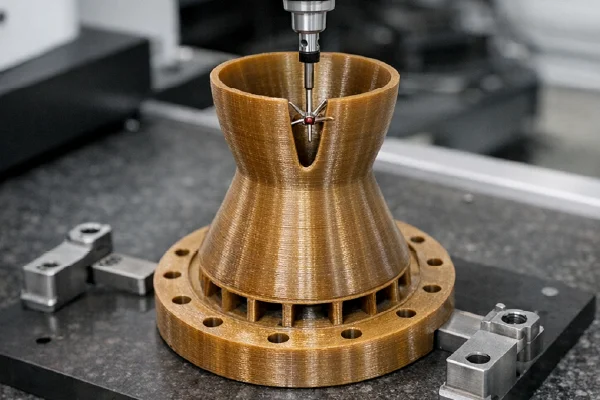
- Dimensional Checks (Calipers and CMM)
- Surface Roughness per ASME Y14.36/ISO 21920-1
- Functional, Form, or Fit Testing
- Tips:
- Use a structured checklist for quality control.
- Document and track deviations.
- Methods:
Applications for stereolithography
The precision, material diversity, and surface quality of stereolithography make it a go-to additive manufacturing technology for prototyping and end-use parts:
- Automotive: Prototyping, custom fixtures, and end-use components.
- Aerospace: Lightweight prototypes, wind tunnel models, and tooling.
- Dental and Medical: Surgical guides, dental models, and custom prosthetics.
- Casting: Investment casting patterns and master models.
- Engineering and Manufacturing: Jigs, fixtures, functional prototypes, and production parts.
Stereolithography Design Tips FAQs
How to design for stereolithography?
Design for stereolithography involves optimizing parts for the manufacturing process—considerations such as part orientation, support structures, and minimizing overhangs. Paying attention to these will lead to successful prints and high-quality components.
How do stereolithography materials affect product design?
SLA materials affect the product design by producing complex geometries, rapid prototyping, and functional testing. The high resolution allows designers to iterate and validate designs quickly before committing to production. The material’s properties, such as flexibility, transparency, or high heat resistance,e can influence the final product’s performance and functionality.
What are the biggest design mistakes one can make with stereolithography?
1. Designing overly complex geometries that are difficult to support during the printing process.
2. Neglecting to account for the shrinkage and warping that can occur during the curing of the resin.
3. Optimizing the orientation of the part minimizes the need for post-processing.
4. Ignoring the limitations of the stereolithography process, such as the maximum build size and resolution.
5. Not considering the material properties and how they will affect the final part’s performance.
What design considerations are necessary for large parts that need to be bonded?
When designing large parts that need to be bonded, consider the following:
- Ensure proper alignment and fit of the parts to be bonded.
- Account for thermal expansion.
- There will be heat contraction during the bonding process.
- Design features that provide adequate surface area for the adhesive.
- Minimize stress concentrations at the bond line.
- Incorporate features that facilitate the application of the adhesive.