When a part needs to flex, bend, cushion, seal, or absorb impact, it is easy to jump straight to molding.
And sometimes that is exactly the right answer.
But the manufacturing decision gets more interesting when the quantity is modest, the design is still evolving, or tooling cost and lead time start to compete with the needs of the program itself.
At that point, the better question is not simply which rubber-like material to specify. It is: What does the part need to do, and what manufacturing path gets there with the right balance of performance, volume, schedule, and cost?
Start With the Application
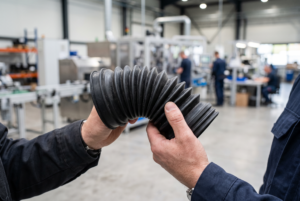
Consider something as ordinary as a protective boot around a sensor or connector. It needs to flex repeatedly, fit the assembly closely, keep debris out, and survive normal handling. The first production need might be only a few dozen pieces, and the design could still change after field testing.
That one part could lead to several very different manufacturing choices. A directly printed elastomer might make sense while the design is moving quickly. A cast urethane version could provide a practical short-run bridge once the geometry settles. If demand grows and the design becomes stable, dedicated molding can become a stronger production option.
The important thing is that the customer should not need to know which acronym or process to ask for before the conversation starts.
Choosing the Right Flexible Material
Flexible materials can behave very differently, and hardness is one useful way to describe how a part should feel and perform.
A soft bellows or seal needs different material behavior than a protective bumper, grip, or vibration-dampening component. The word “flexible” alone does not tell us enough to choose the material or the manufacturing path.
That is where material selection becomes just as important as the process itself. Prototek offers several flexible-material options across additive manufacturing and casting, which gives the manufacturing team room to match the solution to the application instead of forcing the part into one technology.
For example, Prototek’s DLP silicone SIL 30 provides a soft, silicone-like option at 30 Shore A, while SLS Ultrasint® TPU 88A offers a firmer, resilient material suited to applications such as gaskets, cable protectors, seals, and vibration dampeners. Prototek also offers cast urethane elastomers ranging from approximately 5 to 95 Shore A, providing additional flexibility in matching hardness and performance to the application.
The right choice comes back to how the part needs to behave in use. Hardness is one consideration, along with elongation, tear resistance, durability, geometry, operating environment, expected production volume, and the stage of the design.
Tooling Changes the Equation
Direct additive manufacturing is valuable when avoiding dedicated tooling keeps the project moving. Design changes can be made in the digital model, and parts can be produced without first committing to a mold.
That can be especially useful early in a program, but additive is not the only way to avoid hard tooling.
Urethane casting uses a master pattern and silicone mold to produce short runs of parts without the investment required for a production injection mold. Cast urethane is well suited to small runs, with roughly 10–100 parts as a typical range.
That makes casting an important middle path. It can support a project that has moved beyond one-off development parts but is not ready, economically or technically, for dedicated production tooling.
The exact crossover is never just a quantity question. Geometry, material behavior, finish, tolerances, expected revisions, and program life all matter.
Where Additive Starts to Lose Its Advantage
As the design stabilizes and repeat volume grows, the economics can shift toward casting or molding. Additive can also be a weaker fit when the application requires a specific production material or finish that is better served by a molded process.
At higher repeat volumes, injection molding gives the tooling investment more parts over which to spread its cost. The tradeoff is that the project commits more heavily to the design and tooling strategy, so later changes can become more involved.
In other words, tool-less manufacturing is not automatically the better answer. Its value is greatest when flexibility in the manufacturing plan is itself valuable.
A Simple Way to Frame the Choice
The ranges below are decision cues, not hard process limits. Part geometry, material, tooling approach, tolerance, finish, and total program requirements can move the economics in either direction.
| Path | Often a strong fit when… | Volume cue | Main tradeoff |
|---|---|---|---|
| Direct additive | Design is changing, tooling avoidance matters, or geometry favors printing | One-offs through low volume | Material, finish, and unit economics are process-specific |
| Urethane casting | You need a short run with molded-like form and broader elastomer choices | Roughly 10–100 parts | Silicone molds have finite life and must be remade for major changes |
| Injection molding | The design is stable and repeat production can justify dedicated tooling | Repeat production; often hundreds+* | Higher upfront tooling commitment and less flexibility after tooling |
*Directional only. Cases will vary by application and tooling strategy.
Choose the Manufacturing Path, Not Just the Process
The broader opportunity is to make the manufacturing decision before it becomes a design constraint.
For the protective boot example, the answer could be DLP, SLS TPU, cast urethane, or injection molding at different points in the program. The right path depends on how the part needs to perform and what the program needs now, not on forcing the project into a preferred technology.
That is where manufacturing expertise becomes more useful than simply having access to a particular machine or material. A good manufacturing conversation connects function, material behavior, quantity, design maturity, schedule, and total project cost, then uses those requirements to choose the process.
Tell Us About Your Application
Talk with Prototek’s team about what your flexible part needs to do and where the program is headed. We can help evaluate additive, casting, and molding options against the application, volume, schedule, and project goals.