A large additive part can create an unexpected design problem.
The geometry may work. The material may work. The part may be well suited for 3D printing. But if it does not fit within the available build envelope, the design may have to be divided into smaller sections simply so it can be manufactured.
At that point, you are no longer dealing with one component. You are designing an assembly.
That can introduce joints, alignment features, hardware or bonding requirements, additional finishing, and dimensional variation between sections. Each of those decisions can also require additional engineering work, documentation, purchasing coordination, and time in the project schedule.
Sometimes those tradeoffs are perfectly reasonable. Other times, they exist only because the manufacturing equipment was not large enough to produce the original design.
Large-format stereolithography (SLA) gives engineers another option.
When Build Size Starts Changing the Design
Splitting a large part sounds straightforward until you consider what happens next.
Take a large housing as a simple example. If the complete housing will not fit within the available printer, it might be divided into three sections. Now there are two additional joints to design. Those joints need to locate properly, stay aligned during assembly, and produce the intended overall dimensions once everything is put together.
That decision can ripple through the rest of the project. The engineering team may need to address design-for-assembly considerations and tolerance stack-up, determine how the sections will be joined, select fasteners or adhesives, and evaluate any additional failure modes introduced by the assembly. New hardware may need to be added to the bill of materials and sourced through purchasing.
Assembly fixtures, instructions, inspection requirements, and finishing operations may also be needed.
None of those challenges necessarily make the segmented approach wrong.
But they consume engineering resources and schedule that were not required when the component was a single part.
A larger build envelope can make it possible to ask a useful question before making those changes:
Does this part actually need to become an assembly?
What a One-Piece SLA Build Can Eliminate
When the geometry and application support it, producing a large component in one piece can remove several downstream considerations.
There are fewer interfaces to align and less opportunity for dimensional variation to accumulate from section to section. Assembly fixtures, bonding operations, and hardware may be reduced or eliminated.
That can also mean fewer assembly details to engineer, fewer components to manage through the BOM and purchasing process, and fewer assembly-related risks to evaluate. Cosmetic finishing may become simpler because there are no assembly seams to hide.
In the right application, simplifying those downstream requirements can save more than assembly time. It can reduce the engineering effort and schedule associated with turning one component into a multi-part assembly.
This is where large-format SLA becomes more than a matter of machine size.
It can affect the way the part itself is designed.
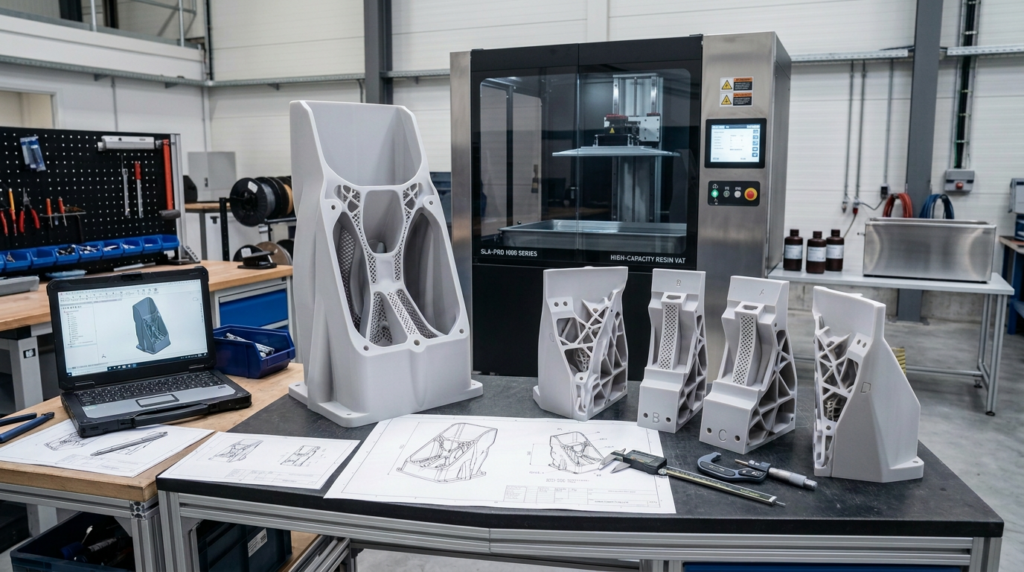
Prototek’s current SLA capability includes a 31 x 31 x 23-inch build size, with published tolerances of ±0.005 inch for the first inch and ±0.0015 inch per additional inch. More than 18 materials are available across the Accura® and Somos® families.
For a designer working near the limits of a conventional build envelope, that additional space can preserve options that might otherwise disappear early in the process.
Large Format Does Not Automatically Mean One Piece
There is an important qualification here: bigger is not always better.
There are plenty of reasons to intentionally divide a large component.
A segmented design might make shipping easier. Individual sections might need to be replaced or serviced independently. Certain surfaces may be easier to finish when the part is separated. Geometry, support strategy, handling, inspection access, or material behavior may also favor a multi-piece approach.
SLA itself brings considerations around orientation, supports, surface requirements, and material selection. Prototek offers multiple finishing options for stereolithography parts, ranging from natural and standard finishes through improved, clear, primed, painted, and custom options.
So the goal is not to make the largest possible part simply because the equipment can accommodate it.
The goal is to avoid introducing joints and assembly work when they do not add value to the design.
Start With the Part You Actually Want
One of the easiest mistakes to make is redesigning a component around an assumed manufacturing limitation before confirming that the limitation exists.
If a large SLA part appears too big to print as designed, it is worth evaluating the complete geometry before adding split lines, alignment features, fasteners, or other assembly requirements.
A qualified SLA 3D printing service can look at the overall part, intended application, resin requirements, tolerances, finishing needs, and build orientation before determining whether a one-piece or segmented approach makes more sense.
That is especially useful for large, detailed components where SLA’s resolution and surface quality are already attractive but the size of the part is beginning to influence the design.
It is one example of how additive manufacturing can solve a design constraint without adding unnecessary downstream complexity.
Sometimes dividing the part is the right manufacturing decision.
Sometimes the simpler solution is not dividing it in the first place.
Frequently Asked Questions
What is large-format SLA 3D printing?
Large-format SLA uses the same resin-based stereolithography process as conventional SLA but provides a larger build envelope, allowing larger components to be evaluated as a single printed part rather than automatically dividing the design into multiple sections.
What are the advantages of printing a large SLA part in one piece?
Depending on the design, a one-piece build can reduce assembly joints, alignment requirements, fixturing, secondary assembly work, and tolerance stack-up between multiple sections. It may also reduce the associated engineering, hardware, BOM, purchasing, and assembly-planning requirements.
Can a one-piece SLA build reduce engineering work?
In the right application, yes. Avoiding unnecessary segmentation can eliminate design-for-assembly work, fastener or bonding decisions, additional failure-mode considerations, assembly documentation, and other tasks associated with converting one component into a multi-part assembly.
Should every large SLA component be printed in one piece?
No. Shipping, serviceability, finishing access, geometry, inspection requirements, material behavior, and other manufacturing considerations can make a segmented design preferable. The better approach depends on the application.
How large can Prototek print with SLA?
Prototek currently lists a maximum SLA build size of 31 x 31 x 23 inches.
Working With a Large Part That You Are Considering Splitting for Additive Manufacturing?
Before redesigning it around a smaller build envelope, send Prototek the complete geometry. Our additive team can help evaluate whether a one-piece SLA build or a segmented approach better fits the application.