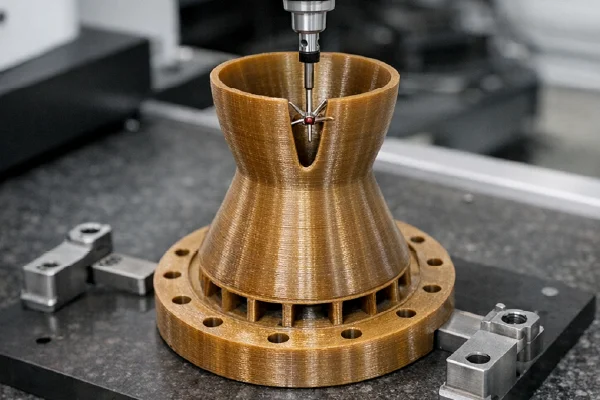
Geometric Dimensioning and Tolerancing (GD&T) improves manufacturing processes by delivering unambiguous, function-based specifications for part features. Paying attention to this will enhance product quality, reduce costs, streamline communication between teams, and optimize designs. It is a standardized approach that ensures all stakeholders, from design to production to inspection, share a common understanding of the requirements. The results? Fewer errors, less rework, and more efficient workflows.
In this blog post, we will explore what GD&T is, its importance, how it functions, and its practical applications in real-world manufacturing scenarios.
A Brief History of GD&T
The origins of GD&T date back to World War II, when Stanley Parker, an engineer at the Royal Torpedo Factory in Scotland, observed the rejection of many parts due to minor deviations that did not impact their function. He introduced the concept of “true position,” enabling a circular tolerance zone rather than a restrictive square one, thereby significantly increasing production efficiency and reducing waste.
The U.S. military adopted Parker’s ideas and formalized them into standards, leading to the development of MIL-STD-8. Today, the modern American Society of Mechanical Engineers (ASME) assumes responsibility for publishing the Y14.5 standard, and internationally, the ISO 1101 standards govern Geometric Dimensioning and Tolerancing (GD&T).
What is GD&T?
GD&T is a standardized symbolic language, for example ASME Y14.5 and ISO 1101, used on engineering drawings and 3D models to specify the acceptable variation in the geometry of manufactured parts. Unlike traditional plus/minus tolerancing, which controls only the size and location of features in the X, Y, and Z directions, GD&T specifies the permissible variation in size, form, orientation, and location. Ensuring that parts will fit and function as intended, even with inevitable manufacturing imperfections.
The Fundamentals of GD&T
- Clear Communication: Eliminates the ambiguity in design specifications.
- Dimension: A numerical value that defines the size, form, orientation, or location of a part or feature.
- Tolerance: The permissible amount of variation in a physical feature, specified directly (e.g., ±0.05 mm) or through geometric controls.
- Feature Control Frame (FCF): A rectangular box on a drawing that specifies the type of geometric control, tolerance value, modifiers, and datum references for a feature.
- Datum: A theoretically exact point, axis, or plane used as a reference for measuring and manufacturing part features. The Datum Reference Frame (DRF) is the foundational coordinate system for all geometric specifications.
Types of Geometric Controls
| Category | Controls |
|---|---|
|
Form |
Straightness, flatness, circularity, and cylindricity. |
|
Orientation |
Perpendicularity, parallelism, and angularity. |
|
Location |
Position, concentricity, and symmetry. |
|
Profile |
Profile of a line or profile of a surface. |
|
Runout |
Circular runout or total runout. |
Each control defines a specific tolerance zone—such as a cylinder, two parallel planes, or a circular band—within which the feature must lie.
GD&T Symbols and Terminology
GD&T utilizes a set of standardized symbols, placed within feature control frames on engineering drawings, to represent various types of tolerances and controls. Here are some of the most common symbols:
| Symbol | Name | Category |
|---|---|---|
|
⏤ |
Straightness |
Form |
|
⏥ |
Flatness |
Form |
|
○ |
Circularity |
Form |
|
⌭ |
Cylindricity |
Form |
|
∥ |
Parallelism |
Orientation |
|
⟂ |
Perpendicularity |
Orientation |
|
∠ |
Angularity |
Orientation |
|
Ⓧ |
Position |
Location |
|
◎ |
Concentricity |
Location |
|
≡ |
Symmetry |
Location |
|
↗ |
Circular Runout |
Runout |
|
↗↗ |
Total Runout |
Runout |
For a complete visual reference, symbol charts and guides are widely available online.
Why use GD&T? What are the benefits?
Clear Communication of Design Intent
- Standardized Language: All teams interpret the project requirements uniformly.
- Supplier Collaboration: Reduces errors and clarifications in outsourced manufacturing.
- Streamlined Documentation: There is a reduced need for lengthy notes. The drawings are clear.
Design Optimization
- Functional Fit: Parts assemble and perform as intended.
- Focus on Critical Features: Tolerances are applied where they matter the most.
- Design for Manufacturability: A balance between design and production capabilities.
Improved Quality and Reduced Errors
- Material and Processing Savings: Allows for looser tolerances where possible, reducing machining and inspection costs.
- Lower Scrap and Rework: Less scrap because there will be fewer out-of-spec parts.
- Shorter Lead Times: Speeds up manufacturing processes, increases efficiency, and reduces time to market.
Standards: ASME Y14.5 vs. ISO GPS
Two primary standards govern GD&T worldwide:
- ASME Y14.5: Predominant in North America and parts of Asia, known for its unified, practical approach.
- ISO GPS (Geometrical Product Specifications): A Modular system used globally, especially in Europe and Asia, with a focus on mathematical rigor and traceability.
Key differences:
- ASME uses the Envelope Principle (size and form are related unless otherwise specified), while ISO uses the Independency Principle (each tolerance is independent unless a relationship is defined).
- ISO standards are more modular and detailed, whereas ASME standards are more unified and accessible for manufacturing environments.
Choosing the proper standard depends on your region, supply chain, and project requirements.
How does GD&T help certain industries?
| Industry | Applications and Benefits | Outcomes |
|---|---|---|
|
Ensures precise alignment of critical compounds reducing rework and scrap. |
Higher quality and lower costs. |
|
|
Improves assembly consistency and reduces fitment issues and warranty claims. |
Fewer stoppages and cost savings. |
|
|
Ensures regulatory compliance and reliable part interfaces. |
Improves reliability and compliance. |
|
|
Manages tight tolerances for high-volume parts and speeds up-time-to market. |
Reduces scrap and faster launches. |
GD&T in the Modern Age
Today, GD&T is integrated with CAD and PLM (Product Lifecycle Management) systems, making the implementation of GD&T in designs easy. Leading CAD platforms, such as SolidWorks, CATIA, and AutoCAD, offer GD&T options that enable the direct application and analysis of tolerances to 3D models. Specialized tools, such as 3DCS and Sigmetrix CETOL 6σ, provide advanced tolerance stack-up analysis and compliance checking.
Common Mistakes and Misconceptions
GD&T can be misunderstood or misapplied. A few common pitfalls to avoid include:
- Neglecting standards or incomplete specifications: Missing references or critical info can lead to ambiguity and errors.
- Errors in defining features and datums: Incorrectly identifying or specifying features and datums can cause assembly failures.
- Misuse of symbols and modifiers: Incorrect application can drastically alter part function or manufacturability.
- Overly restrictive tolerances: Applying tighter tolerances than necessary increases costs and manufacturing difficulty.
- Misconceptions about GD&T’s purpose: Some believe GD&T is only for high-precision parts or that it always increases costs, which is not true.
Proper training, clear communication, and adherence to standards are key to successful GD&T implementation.
Visual Aids: Learning and Applying GD&T
GD&T is a visual language. Symbol charts, feature control frame diagrams, tolerance zone illustrations, and annotated part drawings are all part of understanding and applying Geometric Dimensioning and Tolerancing (GD&T). There are many great online resources, such as the GD&T Basics Symbols Reference Guide, that provide comprehensive visual aids and downloadable booklets for those interested in learning more or seeking references for work.
FAQs
Define: GD&T
Geometric Dimensioning and Tolerancing (GD&T) is a system for defining and communicating engineering tolerances and specifications.
What is the true position in GD&T?
True position in GD&T refers to the exact location of a feature, taking tolerances into account and ensuring proper fit and function.
How to read GD&T?
GD&T, or Geometric Dimensioning and Tolerancing, is a system that defines the allowable variation in part features and tolerances. Understanding GD&T helps ensure accurate and consistent manufacturing.
What is datum in GD&T?
A datum in GD&T is a reference point or surface used to establish the location and orientation of features on a part.
How to do GD&T in SolidWorks?
Use Solidworks’ GD&T tools to define geometric tolerances, control part features, and ensure precise manufacturing. Apply symbols, datums, and tolerance values to effectively communicate design intent.