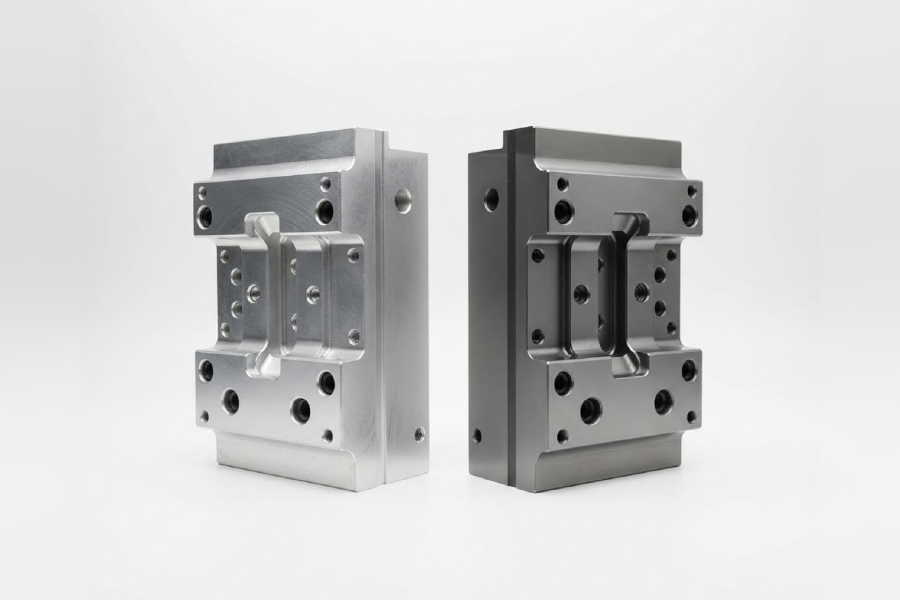
Injection molding can produce everything from automotive parts to medical device components. One of the most consequential decisions is what material to use for the mold. The material will dictate the cost, quality, time-to-market, and production volume. The debate between aluminum and steel tooling is detrimental. Each material offers advantages and disadvantages.
In this blog post, we will take a look at injection molding fundamentals, examine both aluminum and steel tooling, review industry trends, and discuss how to choose the right material for the job.
Injection Molding Tooling Fundamentals
How does injection molding work?
The following is a list of five steps to injection molding:
- Clamping: The machine closes two halves of the mold. It applies enough force to keep it shut under the pressurized injection of material.
- Injection: During this stage, the raw plastic pellets funnel into a heated barrel, where they are melted. Once melted, they are injected into the mold and cooled.
- Packing and Cooling: Under pressure, molten plastic fills the cavity. Water or oil is run through channels to cool and solidify the plastic.
- Ejection: Once the plastic solidifies, the mold opens, and the ejector pins push the finished part.
- Cycle Reset: The mold is closed again, and the process starts over.
Key Components of the Mold or Tooling
| Component | Function | Material Impact |
|---|---|---|
|
Cavity and Core |
Shape the final part’s exterior and interior. |
Hardness, Polishability, and Wear |
|
Runner System |
Channels for the molten plastic. |
Machinability and Wear |
|
Cooling Channels |
Control the mold’s temperature, affecting cycle time. |
Thermal Conductivity |
|
Ejector System |
Removes the finished part. |
Durability and Machinability |
An Overview of Aluminum Tooling
Mechanical Properties of Aluminum Tooling
- Thermal Conductivity: Aluminum is ~5x higher than steel, which is impactful for rapid cooling and shorter cycle times.
- Machinability: Aluminum is 3–10x faster to machine than steel, making it excellent for prototyping and easy modification for low- to medium-volume production runs.
Advantages of Using Aluminum for Tooling
- Lower Costs: $2,000-$10,000 typical for low- to medium-volume aluminum molds.
- Faster Lead Times: Roughly 5 days to 3 weeks, making aluminum molds ideal for rapid prototyping and short production runs.
- Superior Cooling Efficiency: Thanks to aluminum’s high thermal conductivity, the cycles are faster.
- Lighter Weight: Aluminum is easier to handle and install than steel because it is much lighter.
- Ease of Modification: Aluminum offers quick, cost-effective repairs and design changes.
Disadvantages of Using Aluminum for Tooling
- Lower Wear Resistance: With a Brinell hardness of approximately 150-190 HB, alloyed aluminum is more susceptible to wear. It is especially susceptible to abrasive resins.
- Limited Shot Life: For standard aluminum alloys, 10,000-100,000 shots. For advanced alloys, such as QC-10 and Alumold, there may be a possibility of f up to 1M+ shots.
- Susceptibility to Damage: Aluminum molds are prone to dings, scratches, and deformation.
- Geometry Limitations: Features such as thin walls, small cores, and sharp corners can accelerate fatigue.
- Resin Restrictions: Glass-filled, highly abrasive, or high-temperature resins are unsuitable materials to use with aluminum tooling due to wear and tear.
Recommended Uses for Aluminum Tooling
- Prototyping and Bridge Tooling
- Low-to-Medium Volume Production
- Parts Using Non-Abrasive Resins
- Projects with Either Tight Deadlines or Budgets
An Overview of Steel Tooling
Mechanical Properties of Steel Tooling
- Wear Resistance: Steel has high wear resistance, making it an excellent choice for projects that require abrasive and glass-filled resins.
- Surface Finish: SPI A-1 can create mirror-like finishes, especially on 420 stainless steel and NAK80.
- Thermal Conductivity: Steel’s thermal conductivity is lower than that of aluminum’s, resulting in longer cooling times.
Advantages of Using Steel Tooling
- Durability: For premium-grade steel, 10M+ shots are typical.
- Superior Surface Finish: Steel is ideal for high-gloss, optical, or medical parts and is less susceptible to damage than aluminum due to its hardness.
- Material Compatibility: Steel is compatible with all resins, including abrasive and high-temperature resins.
- Multi-Havity, High-Volume Production: This type of production is standard for automotive, consumer goods, and industrial parts. Steel tooling is ideal.
- Maintenance and Repair: Steel is an exceptional material for welding, re-polishing, and other maintenance to extend its life.
Disadvantages of Using Steel Tooling
- High Cost: Steel is much more expensive, ranging from $ 10,000 to $100,000+ for production-grade molds.
- Long Lead Times: 8-12+ weeks and an additional 2-3 weeks for hardened grades of steel.
- Heavy Weight: Steel requires more robust handling and press equipment, due to its weight.
- Difficult Machining: Harder steel grades are time-consuming and costly to machine, requiring specialized tools due to their abrasiveness and tendency to generate heat.
Recommended Uses for Steel Tooling
- High-Volume Production
- All Resins Welcome – Abrasive, Glass-Filled, and High-Temperature
- Parts Requiring Tight Tolerances or Mirror-Like Finishes
- Multi-Cavity Tools for Mass Production
Aluminum vs Steel: A Head-to-Head Comparison
| Criteria | Aluminum Tooling | Steel Tooling |
|---|---|---|
|
Upfront Tooling Cost |
$2,000-$100,000 |
$10,000-$100,000+ |
|
Per-Part Cost (Low-Volume Production) |
The lower, the tooling costs are spread over fewer parts. |
At higher volumes, the tooling costs dominate. |
|
Per-Part Cost (High-Volume Production) |
Increases as the tool wears. |
Very low, the cost is amortized over large quantities. |
|
Mold Lifespan and Shot Count |
10,000-100,000 alloy dependent. |
200K-1M+ grade dependent. |
|
Lead Time |
5 days – 3 weeks |
8 – 12+ weeks |
|
Part Quality (Surface Finish) |
Good, but may show tool marks. |
Excellent, mirror-like finishes are possible. |
|
Dimensional Accuracy |
Good for most applications. |
Excellent for tight tolerances. |
|
Cycle Time (Cooling Speed) |
Faster, due to thermal conductivity. |
Slower, due to lower thermal conductivity. |
|
Material Compatibility |
Most commodity and engineering plastics that are not abrasive. |
All plastics, including abrasive and high-temperature resins. |
|
Maintenance and Repairability |
Easy to modify or repair, and good with frequent repairs. |
Durable, making repairs less frequent, but more difficult to repair. |
|
Scalability |
Ideal for prototyping, low-volume, or bridge production. |
Standard for full-scale production. |
2025-2026 Industry Trends
- Expanding Aluminum Tooling: Advances in aluminum alloys, for example, QC-10 and Alumold, and in machining have expanded aluminum’s role beyond prototyping to select production applications.
- DFM and Mold Flow Simulation with Digital Manufacturing: Automation design tools and simulation can optimize mold design and material selection, reducing costs.
- Sustainability: An increased focus on recyclable mold materials and the use of recyclable plastics is growing.
- Bridge Tooling Strategies: Early production is increasingly using aluminum molds, while steel tooling is being built, accelerating time-to-market.
Choosing Aluminum or Steel Tooling: Things to Consider
Choose Aluminum Tooling When:
- You need prototypes or bridge tooling for early-stage production.
- Your production run is <100,000 parts or up to 1M with advanced alloys and non-abrasive resins.
- You require fast lead times, from days to weeks.
- The resin your project requests is non-abrasive, such as PP, HDPE, ABS, or Nylon.
- Your budget or timeline is tight.
- You anticipate design changes or rapid iteration.
Choose Steel Tooling When:
- Your production run is >100,000 shots.
- Your project requires abrasive, glass-filled, or high-temperature resins.
- Your parts require tight tolerances or mirror-like finished surfaces.
- You need multi-cavity or high-volume production tools.
- Your project requires long-term durability.
When Your Project Requires Bridge Tooling:
- Choose aluminum for prototyping and early production.
- Transition to steel for full-scale manufacturing as demand grows.
Conclusion: Aluminum vs Steel Tooling
The case can be made to use both aluminum and steel tooling, but the application matters. Aluminum offers speed, flexibility, and cost savings for prototyping, low- and medium-volume production runs, and bridge manufacturing. On the other hand, steel is incredibly durable, precise, and great for high-volume, demanding applications. When deciding which is best for your project, consider the volume, resin type, part complexity, timeline, and budget. As always, if you have a question, don’t hesitate to ask our team! Prototek excels at solutions-based manufacturing and production.
FAQs
Is aluminum an acceptable choice for tooling for injection molding?
Yes, aluminum is an acceptable choice for injection molding tooling. It offers good thermal conductivity, lightweight, and cost-effectiveness compared to steel tooling.
Is steel an acceptable choice for tooling for injection molding?
Yes, steel is an acceptable choice for injection molding tooling. It offers durability, precision, and the ability to withstand the high pressures and temperatures necessary for the injection molding process.
Aluminum vs steel tooling, how to choose for my project?
When choosing between aluminum and steel tooling for your project, consider the following factors:
- Part complexity and detail:
- Aluminum tooling is better for complex, high-detail parts.
- Steel tooling is more suitable for simpler, high-volume production.
- Production volume:
- Aluminum tooling is cost-effective for low- to medium-volume production.
- Steel tooling is more durable and efficient for high-volume production.
- Lead time:
- Aluminum tooling has a shorter lead time.
- Steel tooling takes longer to manufacture.
- Tooling lifespan: Steel tooling has a longer lifespan and can withstand higher production volumes than aluminum tooling.
Does Prototek machine both aluminum and steel tooling?
Yes, Prototek machines both aluminum and steel tooling to meet a wide range of customer needs.
Does Prototek offer injection molding services?
Yes, Prototek offers injection molding services as part of our comprehensive manufacturing capabilities.