Cast urethane materials are some of the most flexible polymers in modern manufacturing. They offer an outstanding balance of durability, flexibility, and customization. Understanding the most common cast urethane materials is crucial, whether you are creating prototypes, producing end-use parts, or seeking specialized performance, including knowing their properties, applications, and handling requirements.
In this blog post, we will examine the top 10 cast urethane materials, compare their strengths, and offer guidance on how to select, process, and comply with them.
1. AFP3100 (85 Shore D)
Overview:
AFP3100 is a strong and durable rigid urethane resin. It is well-known for its ability to resist heat and impact. This material is crucial in industries where durable and long-lasting components are required. It helps ensure reliability in critical applications.
Physical & Chemical Properties:
- Hardness: It measures 85 Shore D, which means it resists indentation and deformation well.
- Impact Resistance: It can withstand physical shocks and stress, making it ideal for high-performance use.
- Heat Resistance: It maintains its shape at high temperatures, preventing deformation and damage.
- Dimensional Stability: It keeps its shape and size over time, even in changing conditions, ensuring reliable performance.
- Moisture Absorption: It absorbs minimal moisture, which helps prevent swelling, warping, and breakdown, resulting in a longer product life.
Applications:
- Consumer Electronics Housings: This enclosure protects against physical damage and temperature changes. It helps ensure that electronic devices remain reliable and last longer.
- Medical Equipment Casings: We make strong and sterile housings for medical devices. These housings protect the devices and follow strict industry standards.
- Structural Prototypes: I create strong physical models for testing and development in engineering and design. Helping accurately show what the final products will look like.
Processing & Handling:
- Curing Process: The curing process requires careful temperature control to achieve optimal results. Requiring specialized equipment to maintain a consistent temperature.
- Moisture Sensitivity: To ensure the final product remains strong, carefully manage environmental conditions during processing to prevent moisture from getting in.
- Molding Techniques: Casting occurs in either open or closed molds, depending on the desired finish and the complexity of the part. This process ensures optimal surface quality and precise dimensions.
2. AFP3200 (80 Shore D)
Overview:
AFP3200 is similar to high-density polyethylene (HDPE). This material has strong tensile strength and excellent impact resistance. It is valued for its durability and flexibility, making it suitable for many industrial and commercial uses.
Physical & Chemical Properties:
- Hardness: The material has a hardness of 80 Shore D, making it firm and durable.
- High Tensile Strength: It can resist tension and stress without bending or breaking, making it ideal for demanding applications.
- Excellent Impact Resistance: It can absorb strong shocks, helping to prevent damage in high-impact situations.
- Good Chemical Resistance: It withstands various chemicals, ensuring it remains stable and durable in different environments.
Applications:
- Industrial Piping: Utilized in various piping systems for the transport of liquids and gases, where strength and reliability are crucial.
- Consumer Packaged Goods: Frequently employed in the packaging of consumer products, providing durability while maintaining an aesthetically pleasing appearance.
- Automotive Body Components: Used in the manufacturing of components for vehicles, offering a balance of lightweight characteristics and structural integrity.
Processing & Handling:
- Pigmentation: You can easily add color to the material for custom color matching to suit your brand and design needs.
- Degassing Requirement: It’s essential to remove any trapped air from the material during processing. Preventing bubbles from forming, which could affect the final product’s quality.
- Curing Process: The material cures well at moderate temperatures. Making it easy to use in different manufacturing settings while ensuring it performs effectively.
3. AFP3320 (80 Shore D)
Overview:
AFP3320 is renowned for its exceptional heat and impact resistance, making it a top choice for high-temperature applications. Its ability to withstand extreme conditions ensures it lasts long and remains reliable in harsh environments.
Physical & Chemical Properties:
- Hardness: It measures 80 Shore D, which means it is tough and resistant to scratches. Helping it keep its shape under stress.
- Heat Resistance: It can withstand high temperatures without breaking down, allowing it to function effectively in hot environments while maintaining its strength.
- Mechanical Stability: It retains its strength even at high temperatures, making it suitable for parts that experience prolonged heat and stress.
Applications:
- HVAC Components: These materials are common in heating, ventilation, and air conditioning systems. They need to handle temperature changes effectively to work efficiently.
- Underhood Automotive Parts: These materials are ideal for components located in the engine compartment, which are exposed to high heat and vibration.
- Industrial Machinery Housings: These materials provide robust protection for machinery housings, making them durable and reducing the need for maintenance.
Processing & Handling:
- Post-Curing Process: To achieve optimal heat resistance, a controlled post-curing process is necessary. It will help the final product withstand high temperatures.
- Humidity Sensitivity: The material exhibits a reaction to humidity during the mixing and pouring process. It’s essential to work in a dry environment to prevent issues such as premature curing or weakened material properties.
4. AFP3400 (70 Shore D)
Overview:
AFP3400 offers a great mix of flexibility and impact resistance. It is ideal for parts that bend or move a lot. This material is best suited for situations where strength and durability are crucial.
Physical & Chemical Properties:
- Hardness: The material has a hardness rating of 70 Shore D, indicating that it is firm yet still flexible.
- Flexibility: It is very flexible, allowing it to bend and return to its original shape without any damage.
- Impact Resistance: The material can resist substantial impacts, which helps it last and perform well even in harsh conditions.
Applications:
- Living Hinges: Ideal for creating durable, flexible joints that enable smooth motion between two parts.
- Flexible Connectors: Ideal for applications that require adjustable links to withstand continuous movement without compromising integrity.
- Dynamic Seals: Highly effective in sealing applications where movement occurs, preventing leaks and maintaining system integrity.
Processing & Handling:
- Casting: The material can be shaped into thin sections, enabling a wide range of designs and applications.
- Mixing Requirements: It is essential to mix the components thoroughly and evenly. Ensuring that the part maintains the same flexibility and performance throughout, thereby preventing any weak spots that could compromise its function.
5. AFP3600 (~82 Shore D)
Overview:
AFP3600 is a high-performance urethane material that can be colored and exhibits excellent properties, making it useful for various applications where both transparency and color accuracy are essential.
Physical & Chemical Properties:
- Hardness: Approximately 82 Shore D, providing a balance of flexibility and rigidity suitable for various demands.
- Optical Clarity: Exhibits exceptional transparency, allowing for clear visibility and minimal distortion, which is essential for applications such as lenses and display panels.
- UV Stability: Enhanced ultraviolet resistance by incorporating UV stabilizers, making the material suitable for outdoor environments where prolonged exposure to sunlight can cause material degradation over time.
Applications:
- Lenses: Utilized in optical devices due to their clarity and durability.
- Light Housings: Perfect for protective casings that require both aesthetic appeal and functional performance.
- Backlit Panels: Employed in illuminated displays where light diffusion and visibility are critical.
Processing & Handling:
To keep AFP3600 in good condition, handle it carefully to avoid trapping air during processing. Trapped air can affect the material’s optical properties. If the application will be outdoors, add UV stabilizers. It will help the material last longer and function more effectively.
6. PT8958 (85 Shore D)
Overview:
PT8958 is a special material designed for use in medical devices. It allows clear MRI images without any interference. It is also flame retardant, which helps keep both patients and healthcare workers safe. These features make it an excellent choice for devices that require safety and reliability in medical settings.
Physical & Chemical Properties:
- Hardness: 85 Shore D, providing robust durability and resistance to deformation.
- MRI Transparency: Ensures that the material does not interfere with magnetic resonance imaging, allowing for precise diagnostics.
- Flame Retardancy: Designed to reduce the risk of fire hazards, making it safer for use in various medical environments.
- Biocompatibility: Meets stringent biocompatibility standards, ensuring safe, prolonged contact with biological tissues.
Applications:
- Medium to Large Medical Device Housings: These casings protect medical devices during daily use in clinics.
- Components for Diagnostic Equipment: These parts, including probes and casings, are designed for reliable performance in a wide range of conditions.
Processing & Handling:
- Cleanroom Processing: All fabrication must occur in cleanroom environments to ensure the material remains safe for use in medical applications and to prevent contamination.
- Post-Cure Requirement: The material needs a post-curing process to improve its flame-retardant properties, ensuring it is safe for medical use.
7. RC 79D (85 Shore D ±5)
Overview:
RC 79D is a highly durable and impact-resistant urethane specifically formulated for use in small medical devices and assemblies where both precision and long-lasting performance are critical. Its robust characteristics make it an ideal choice for applications that demand high reliability.
Physical & Chemical Properties:
- Hardness: 85 Shore D (±5), providing a strong balance between rigidity and flexibility.
- Toughness: Exhibits exceptional resistance to impact and stress, ensuring that it can withstand the rigors of everyday use in medical environments.
- Dimensional Accuracy: Maintains excellent dimensional stability, ensuring precise fitting and assembly of components, which is crucial in medical applications.
Applications:
- Small Medical Device Housings: These housings protect and support sensitive medical devices, such as sensors, monitors, and surgical instruments. They are suitable for many different types of medical equipment.
- Precision Assemblies: These assemblies are engineered for components that demand accurate and dependable performance, ensuring the effective operation of medical devices.
Processing & Handling:
- Mold Compatibility: RC 79D is designed for intricate mold designs, enabling the production of complex shapes and features that meet stringent medical standards.
- Demolding Care: Special attention is required during the demolding process to avoid potential damage to delicate parts. Implementing appropriate techniques and tools is essential to preserving the integrity of the final product.
8. E1005AL (5 Shore A)
Overview:
E1005AL is a soft and flexible elastomer. It is for use in environments that require both softness and durability. Its special formula makes it suitable for many creative projects.
Physical & Chemical Properties:
- Hardness: The material has a hardness of 5 Shore A, making it very soft and flexible.
- Tensile Strength: It resists stretching and breaking well, which helps it withstand more challenging situations for longer.
- Tear Strength: The material is resistant to tearing, reducing the likelihood of damage during use.
- Elongation: It can stretch significantly without being damaged, which increases its usefulness in various applications.
Applications:
- Medical Training Models: These models help medical professionals practice with realistic human tissue simulations.
- Special Effects Props: These props create realistic effects for movies and theater. They feel soft and look lifelike.
- Soft-Touch Grips: These grips make tools and devices easier to hold, improving comfort and control.
Processing & Handling:
- The material is sensitive to air bubbles; therefore, vacuum degassing is necessary before curing to achieve a flawless finish.
- It cures effectively at room temperature, allowing for ease of use in various environments and applications without the need for additional heating equipment.
9. E1060AL (60 Shore A)
Overview:
E1060AL is a medium-hard elastomer that balances flexibility and strength. This combination makes it suitable for many dynamic uses in industrial and commercial settings.
Physical & Chemical Properties:
- Hardness: This material has a hardness of 60 Shore A, indicating it is moderately complex. It is both strong and flexible.
- Abrasion Resistance: It resists wear very well, making it a suitable choice for situations with high friction and contact.
- Flexibility: This material has moderate flexibility, allowing it to bend under stress without getting permanently deformed.
Applications:
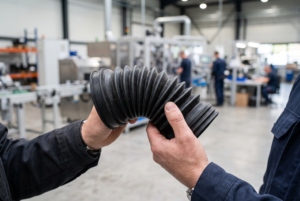
- Bellows: The E1060AL is ideal for creating flexible partitions that can adapt to changes in pressure and volume. It is helpful in systems that require movement.
- Boots: These protective covers are strong and flexible. They help keep components safe from dirt, moisture, and wear and tear.
- Overmolded Components: You can combine elastomers with rigid materials to enhance product performance and durability. Providing the strength of hard materials, combined with the flexibility of the elastomer.
Processing & Handling:
- Overmolding Capabilities: You can easily overmold E1060AL onto different hard materials. This process enhances the adhesion of materials, enabling the creation of strong, multi-material components.
- Curing Requirements: It is crucial to maintain accurate temperature control during the curing process. Helping achieve the best material properties and performance. Proper handling will ensure the final product lasts longer and performs better.
10. E1095AB (95 Shore A)
Overview:
E1095AB is a robust elastomer that performs well in demanding environments. Its high resistance to wear and tear makes it an excellent choice for applications where durability is essential.
Physical & Chemical Properties:
- Hardness: The material has a hardness rating of 95 Shore A, indicating that it is firm yet flexible, retaining its shape under pressure.
- Abrasion Resistance: It can withstand significant wear and friction, making it ideal for regular use in demanding conditions.
- Tear Strength: The material can resist strong forces without breaking, which helps prevent failures in essential situations.
Applications:
- Shopping Cart Wheels: Engineered to provide smooth mobility while enduring the rigors of frequent use in retail environments.
- Rollers: Utilized in various machinery and equipment, ensuring efficient operation and longevity even under heavy loads.
- Bumpers: Provide adequate impact protection, absorbing shock and preventing damage in high-traffic areas.
Processing & Handling:
To produce E1095AB, we require robust mold designs that can withstand high demolding forces without bending or breaking. A post-curing process may also be necessary to enhance the material’s resistance to wear, ensuring it performs optimally in its intended applications. This careful handling and processing help ensure the final product lasts longer and is reliable.
FAQs
What is cast urethane?
Cast urethane is a versatile material used for durable, high-quality parts.
What are common cast urethane materials?
Common cast urethane materials include flexible, rigid, and high-performance grades for various applications.
What are the benefits of cast urethane materials?
Cast urethane materials offer superior durability, flexibility, and wear resistance, making them ideal for a wide range of applications.
What are the negatives of cast urethane materials?
Limited durability, potential for surface imperfections, and longer lead times compared to other manufacturing processes.