A prototype has passed its initial tests. The geometry works, the design has been refined, and the program is ready to move forward.
Now the question changes:
Can you make the same part 50 more times and get the same result?
That is the difference between demonstrating technical feasibility and establishing a production process.
A successful additive prototype proves that a part can be made. Moving from prototype to production requires a broader evaluation. The complete manufacturing process must be able to deliver the required finished component consistently, at the necessary production rate, with the appropriate inspection and documentation, and at a cost that continues to make sense as demand grows.
For engineers evaluating additive manufacturing for production, the printer is only one part of that equation.
A Successful Prototype Answers Only the First Question
Prototyping is designed to answer important development questions. Does the geometry work? Does the part fit? Can the design perform its intended function? Is the material appropriate enough to move into further testing?
Those are important milestones, but they do not automatically establish production readiness.
Production introduces a different set of expectations. Critical dimensions and tolerances must remain consistent. Mechanical or application-specific requirements need to be understood and verified. Inspection, documentation, traceability, post-processing, capacity, and cost all become part of the manufacturing plan.
A prototype program can often accommodate more iteration and hands-on attention because the objective is learning. A production process needs to turn what was learned into something repeatable.
That distinction becomes particularly important in aerospace and defense applications, where inspection, traceability, documentation, supplier qualifications, and process discipline may be important parts of the production requirement.
Production Requires Control of the Process, Not Just the CAD File
One of the attractions of additive manufacturing is its digital foundation. A CAD model can move quickly from engineering to manufacturing.
But production 3D printing is not simply a matter of storing the correct file and pressing print again.
The finished result may also depend on the material, additive technology and equipment, build orientation, support strategy where applicable, thermal behavior, process parameters, and the operations performed after the build. Change one of those inputs, and the resulting part may not be equivalent even when the CAD geometry has not changed.
This does not mean every application requires an elaborate qualification program. It means the manufacturing team needs to understand which parts of the process affect the customer’s actual requirements and control them accordingly.
The goal is not simply to reproduce the digital model. It is to establish a manufacturing process capable of reproducing the required finished part.
The Print Is Only Part of the Manufacturing Processes
An additive component rarely exists in isolation from the steps that come before and after printing.
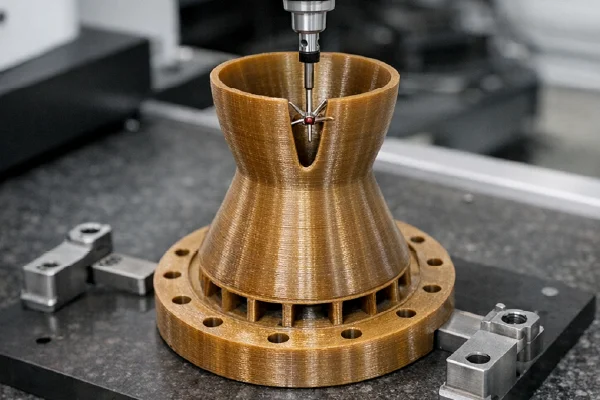
Depending on the application and additive process, the finished component may also require support removal, heat treatment, CNC machining, hole or thread finishing, surface finishing, coating, assembly, dimensional inspection, or other testing and verification.
Those operations should be considered part of the manufacturing strategy rather than cleanup work added at the end.
For example, a hole that was acceptable as printed during prototype evaluation might become a critical locating feature or threaded interface in production. Machining that feature may provide a more practical path to the required final condition.
Similarly, a build orientation that makes sense from a printing standpoint may create additional support removal, finishing, or machining work downstream. Optimizing the additive build without considering those later steps can simply move time, cost, or complexity somewhere else in the process.
The more useful question is not, “Can we 3D print this?” It is, “What manufacturing process will consistently deliver the finished part we need?”
Sometimes the answer is additive alone. Sometimes it is additive followed by machining or finishing. Sometimes it is another manufacturing method entirely.
Five Questions to Ask Before Moving an Additive Part Into Production
If production is the eventual goal, thinking about these issues during prototyping can make the transition much easier. They can also provide a useful framework for working through the production plan with your manufacturing partner while the design still has room to evolve.
1. What requirements actually matter to the application?
Start by separating critical requirements from preferences.
Which dimensions control fit or function? What mechanical performance matters? Are surface condition, weight, temperature exposure, chemical resistance, or other environmental factors important? What documentation and inspection requirements apply?
The clearer those requirements are, the easier it becomes to build a manufacturing process around them.
2. Is the additive process and material right for those requirements?
A process that works well for an early prototype may not automatically be the right production choice.
The selected additive technology and material should be evaluated against the actual production requirements, including geometry, tolerances, performance, quantity, lead time, and total manufacturing cost.
The question is application fit, not whether a particular printer is technically capable of building the geometry.
3. What needs to happen after the build?
The required delivery state should be understood early.
If the component needs machining, heat treatment, finishing, coating, hardware, assembly, or marking, those operations may influence orientation, design details, allowances, manufacturing sequence, and inspection planning.
Thinking about the finished part from the beginning can prevent the additive step from being optimized at the expense of everything that follows it.
4. How will each part be verified?
Inspection should be considered when the manufacturing process is developed, not after the first production run is complete.
The team should understand which characteristics need verification, how they will be inspected, what documentation must accompany the parts, and whether traceability requirements apply.
For demanding applications, production confidence comes from a controlled process supported by verification, not simply from inspecting the finished component.
5. What happens when demand increases?
A manufacturing approach that works for a handful of development parts may behave differently when the requirement becomes dozens, hundreds, or an ongoing production schedule.
Additive build capacity is only one consideration. Post-processing throughput, machining or finishing capacity, inspection requirements, material availability, and overall cost can all affect the viability of the production plan.
This is also the point where the manufacturing process itself deserves another look.
Sometimes the Production Answer is Not Additive
Using additive manufacturing for the prototype does not obligate the program to use additive forever.
As the design stabilizes and quantities increase, CNC machining, molding or casting, sheet metal fabrication, or another process may become more practical for production.
That is not a failure of additive manufacturing. In many cases, additive has already done exactly what the development team needed it to do by enabling rapid iteration, testing, and design refinement without committing to production tooling or a fixed manufacturing strategy too early.
In other applications, additive may remain the right production method because of complex geometry, part consolidation, low- or moderate-volume economics, weight requirements, supply-chain considerations, tooling avoidance, or other application-specific advantages.
There is also a middle ground. An additive component may be printed to create the geometry efficiently, then machined, finished, assembled, and inspected using conventional manufacturing processes.
The manufacturing method should be reevaluated as the program matures rather than assuming that the prototype process must become the production process. That evaluation can benefit from a manufacturing partner that is able to look beyond a single technology and consider additive, machining, finishing, inspection, and other requirements as parts of the same production plan.
From a Successful Part to a Reliable Manufacturing Process
Moving additive manufacturing from prototype to production is ultimately a change in perspective.
The prototype asks whether the concept can work. Production asks whether the complete manufacturing system can deliver the required result again and again.
That means looking beyond the build itself to material, process control, post-processing, secondary machining, finishing, inspection, documentation, capacity, and economics.
For aerospace and defense programs, those considerations may also include more formal requirements for quality systems, traceability, information security, and supplier readiness. Prototek supports these applications with AS9100D and ISO 9001:2015 certified quality systems, ITAR registration, and CMMC Level 2.
With additive manufacturing, CNC machining, finishing, assembly, and inspection capabilities, Prototek can help customers look at that production path as a complete manufacturing problem rather than simply an additive build. The objective is to determine what combination of processes will reliably deliver the finished part as requirements and volumes evolve.
A successful prototype is an important milestone. The next step is making sure the manufacturing process is ready to grow with it.
Frequently Asked Questions
Can additive manufacturing be used for production parts?
Yes. Additive manufacturing can be a viable production method when the selected process, material, post-processing, inspection strategy, production rate, and economics align with the application’s requirements.
What changes when an additive prototype moves into production?
The focus expands from proving that the design works to demonstrating repeatability. Production planning typically considers process control, critical tolerances, inspection, documentation, post-processing, capacity, and cost across the expected quantity.
Should I use the same additive process and material for production that I used for the prototype?
Not automatically. Prototype decisions may have been optimized for speed, availability, or learning. Once the design is more mature, the process and material should be reevaluated against the final performance, quality, volume, lead-time, and cost requirements.
How does production volume affect the choice between additive and other manufacturing processes?
As volume changes, so do manufacturing economics and capacity requirements. Additive may remain appropriate for certain applications, while machining, molding, casting, fabrication, or a hybrid manufacturing strategy may become more practical for others.
Evaluating the next step after a successful prototype?
If your additive prototype is working and production is the next question, talk with Prototek’s engineering team about the finished-part requirements, expected quantities, secondary operations, inspection needs, and manufacturing options.