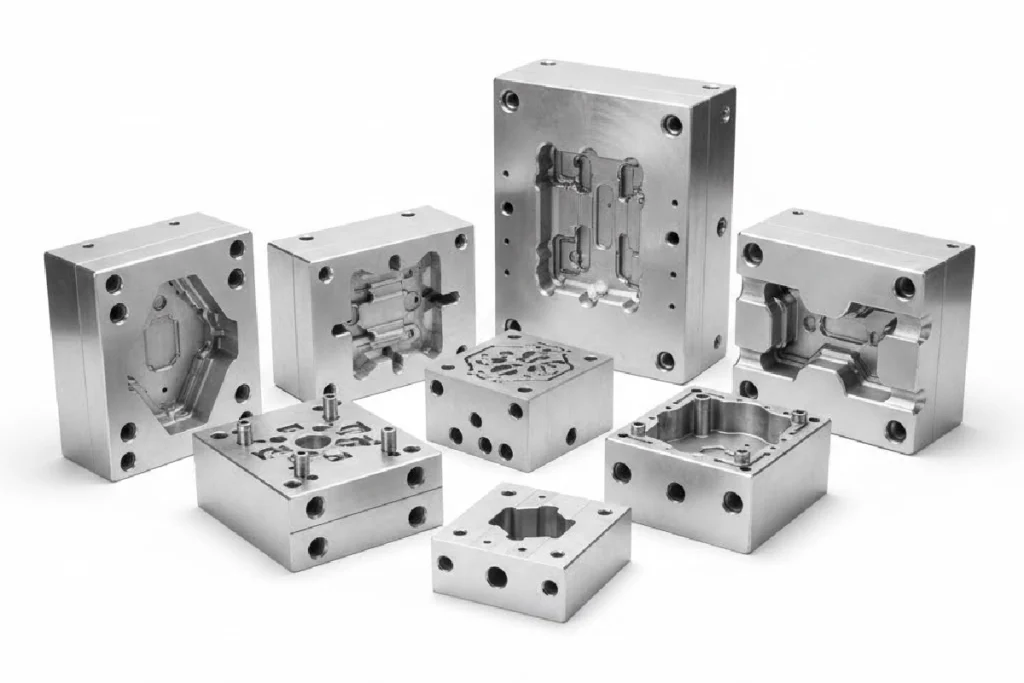
Aluminum tooling was used primarily for prototyping and was unsuitable for high-volume injection molding. In the past, concerns centered around the tools’ service life, wear resistance, and compatibility with certain resins, leading many manufacturers to use steel. With advancements in alloy technology, surface treatments, and mold design. These days, aluminum molds are used across the production lifecycle, from prototyping to medium- and high-volume production runs.
In this blog post, we will discuss the evolution of aluminum tooling. The alloys that have contributed to its increased use, a brief comparison of aluminum vs. steel tooling, and more. If you’re considering using aluminum for your injection molding project or have questions, please don’t hesitate to reach out to our team!
The Evolution: How aluminum tooling is becoming a production powerhouse.
During the 1980s and 1990s, aluminum molds first gained traction as a rapid prototyping option—the ease of machining and the abundance of aluminum facilitated the adoption. The introduction of aerospace-grade alloys, such as 7075, marked a turning point. Alloys such as this one are known for their high strength and exceptional machinability, allowing for a substantial number of molding cycles. In some cases, aluminum alloys can challenge steel’s dominance, especially given the cost savings.
Key Aluminum Alloys for Aluminum Tooling
| Alloy | Typical Use Cases | Notable Properties |
|---|---|---|
|
7075 |
Prototypes and Production Molds |
High Strength and Excellent Machinability |
|
QC-10 |
Production Molds |
Machinability, Polish-ability, and Corrosion Resistant |
|
Alumold |
Production Molds |
Range of Grades, Tailoring for Molds, High Strength, and Stability |
|
7050 |
Production Molds |
High Strength and Stability |
|
5083 |
Large Molds |
Weldability and Moderate Strength |
|
6061 |
General Purpose and Large Molds |
Machinability and Weldability |
The workhorses of high-volume production are 7075 and QC-10. They offer superb balances of strength, machinability, and thermal performance. Alumold and 705 are great options for demanding applications. The use of 5083 and 6061 is common for complex or large molds.
Comparison: Aluminum vs. Steel Tooling
Cycle Time and Thermal Conductivity
- Aluminum Molds: Offer a 25% reduction in cycle times and a 50% or more reduction in cooling time compared to steel, with optimized designs.
- Steel Molds: Longer cooling phases due to lower thermal conductivity.
Tool Life and Shot Counts
- Aluminum Tooling: Typical shot life is 10,000 to 100,000+.
- Steel Tooling: Typical shot life is 500,000 to 1,000,000+.
- Note: The tool life of aluminum depends on several factors, notably the alloy, resin, and maintenance. Advanced alloys and coatings may increase shot counts.
Surface Finish and Dimensional Stability
- Surface Finish: Aluminum can achieve Class A finishes, but it is more susceptible to wear when used with abrasive resins.
- Dimensional Stability: Aluminum is well-suited to most applications, though it requires careful design for tight tolerances due to its higher thermal expansion.
Wear Resistance
- Steel: Superior to aluminum, especially for glass/mineral-filled or corrosive resins.
- Aluminum: Hard coatings can improve it, as can steel inserts in high-wear areas.
Cost and ROI: Aluminum vs. Steel Tooling
| Metric | Aluminum Tooling | Steel Tooling |
|---|---|---|
|
Upfront Cost |
$1,000-$6,000 |
$25,000-$100,000+ |
|
Lead Time |
1-3 Weeks |
8-12 Weeks |
|
Typical Lifespan |
1,000-50,000 Cycles |
100,000-1,000,000+ Cycles |
|
Best Use Case |
≥25,000-100,000 Parts |
>100,000-1,000,000 Parts |
Design and Engineering Best Practices
Mold Design Strategies
- Wall Thickness: Thermoplastic families have a recommended minimum wall thickness to prevent warping and sinking during cooling. Feel free to contact us if you’ve got questions about a specific thermoplastic! As a general rule, we suggest a wall thickness of 1-3.5 mm, with a consistent thickness across the entire part.
- Drafts for Part Ejection: For both aluminum and steel tooling, adding drafts to the mold will improve part moldability. Making this effort will improve surface finishes, discourage bending, breaking, or warping caused by excessive molding stresses during cooling, and facilitate smoother ejection.
- Add Radii to the Corners: At Prototek, we CNC-machine the molds. Machining sharp corners is difficult and can weaken the mold’s structural integrity. We recommend using radii in the injection tooling’s design.
Resins and Material Selection for Aluminum Tooling
- Best-Suited: Softer, less abrasive thermal plastics, such as polypropylene, polyethylene, and acrylonitrile butadiene styrene.
- Challenging: Glass-filled, mineral-filled, or corrosive resins, such as glass-filled nylon and polyvinyl chloride, require surface treatments or hybrid mold designs.
Failure and Mitigation Strategies for Aluminum Molding
Regular inspection, preventative maintenance, and smart design choices can maximize tool life and part quality.
| Failure | Mitigation |
|---|---|
|
Surface Wear and Erosion |
Hard Coatings and Steel Inserts in High-Wear Areas |
|
Deformation and Cracking |
Optimized Mold Design and Stress Reduction |
|
Chemical Attack |
Nickel Plating and Resin Selection |
|
Dimensional Drift |
Careful Thermal Management and Regular Maintenance |
Surface Treatments and Coatings for Aluminum Tooling
These treatments can dramatically enhance and extend the life of aluminum tooling, making it viable for higher-volume and more demanding applications.
- How does hardcoat anodizing help with the longevity of aluminum molds? This process increases the surface hardness and wear resistance of aluminum.
- How does nickel plating help with the longevity of aluminum molds? This process adds corrosion resistance and durability to aluminum and is important when using abrasive or corrosive resins.
- How do PVD coatings help with the longevity of aluminum molds? These coatings further enhance the surface hardness and reduce friction.
Conclusion
Key Finding: A game-changer for manufacturers seeking speed, flexibility, and cost savings, aluminum tooling is becoming more essential for high-volume injection molding.
When to choose aluminum tooling? When you need to launch or go to market quickly, production volumes are 100,000 parts or less, design changes are likely, or cost efficiency is a priority.
When to choose steel tooling? When the production volume exceeds 100,000 parts, the requirements include extreme wear resistance, tight tolerances, or highly abrasive/corrosive resins.
What does the future hold for aluminum tooling? With ongoing advancements in alloys, coatings, and hybrid mold designs, the role of aluminum molds will continue to grow.
FAQs
How are aluminum molds made at Prototek?
Aluminum molds are typically manufactured at Prototek through CNC machining, in which computer-controlled machines precisely cut and shape aluminum to the desired mold design. The process may include milling, drilling, and finishing to create a high-quality, durable mold suitable for injection molding or other manufacturing processes.
Can Prototek use aluminum tooling for injection molding?
Yes, Prototek can use aluminum tooling for injection molding. Aluminum tooling offers several advantages, including speedy turnaround times, lower costs, and the ability to produce high-quality parts with excellent surface finishes. Prototek’s experienced team can design and manufacture aluminum molds to meet your specific injection molding needs.