Getting quality, well-designed products to market quickly keeps the market competitive. It makes a difference in profitability, market share, and building customer loyalty to your brand. Two manufacturing technologies that deal with both commodity and engineering plastics are central to achieving your goals – injection molding and 3D printing (additive manufacturing). While injection molding continues to rule mass production, additive manufacturing allows for cost-effective prototyping and customization.
In this blog post, we will discuss the differences, similarities, advantages, and limitations to help you choose the right process for your needs. If you have questions, please don’t hesitate to reach out! Our engineers at Prototek will be happy to discuss your specific requirements and potential solutions.
Technical Overview: Injection Molding vs 3D Printing
How does injection molding work?
- Clamping: The mold halves are closed and clamped together under pressure.
- Injection: Using heat, plastic pellets melt. Then the injection of the molten plastic into the mold cavity is done under high pressure.
- Cooling: As the material cools in the mold, it solidifies into the part.
- Ejection: The mold opens, and ejector pins push the finished part out.
Are there variations in injection molding?
- Thermoplastic Injection Molding: The most common type of injection molding. Uses resins such as ABS, PP, and PE.
- Thermoset Molding: For materials that cure irreversibly.
- Overmolding and Insert Molding: The combination of materials or encapsulations of hardware inserts for assembly.
What tolerances and surface finishes does injection molding deliver?
- Tolerances: Typically ±0.005 in (0.127 mm). High-precision molds achieve ±0.001 in (0.025 mm).
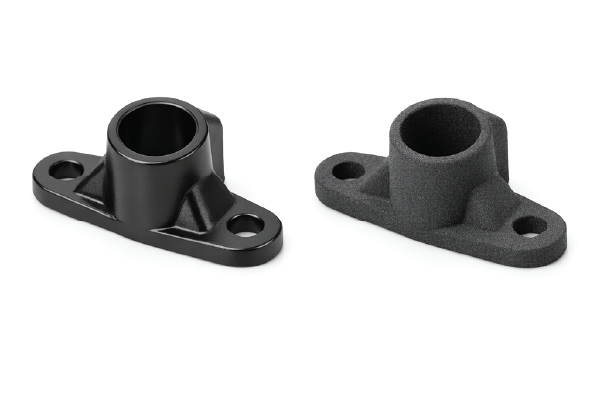
- Surface Finish: This can range from high-gloss (SPI-A) to textured (Mold-Tech and VDI)
How do 3D printing technologies work?
- Selective Laser Sintering: Using a CO2 laser, selective laser sintering fuses nylon-based thermoplastic powder layer by layer.
- Multi-Jet Fusion: Using fusing and detailing agents, multi-jet fusion selectively applies them to a nylon-based powder layer by layer and fuses it with heating elements.
- Stereolithography: Using a UV laser, stereolithography creates components by drawing thin layers of each part in a vat of liquid thermoset resin.
- Digital Light Processing: Using a digital projector, digital light processing flashes each layer onto a vat of photosensitive resin.
- Hybrid PhotoSynthesis: Using both a CO2 laser and a projector, hybrid photosynthesis cures the layers of a component in a vat of resin.
- Fused Filament Fabrication: Using a heating source, fused filament fabrication extrudes thermoplastics layer by layer to form components.
- Material Jetting: Using small droplets, material jetting sprays a liquid photopolymer onto a build platform layer by layer.
What tolerances and surface finishes do additive manufacturing technologies deliver?
- Selective Laser Sintering:
- First inch ±0.005 in and ±0.002 in/in additional inches.
- Matte, grainy, and slightly textured finish similar to medium-grit sandpaper.
- Multi-Jet Fusion:
- ±0.010 in for the first inch and ±0.003 in/in for each additional inch.
- A matte, slightly grainy finish.
- Stereolithography:
- ± 0.005 in for the first inch and ± 0.0015 in/in for each additional inch.
- Typically, it ranges from 0.05 µm to 0.5 µm (2 µin to 20 µin) Ra.
- Digital Light Processing:
- Depends on the part’s geometries.
- Exceptional detail and smooth surfaces.
- Hybrid PhotoSynthesis:
- First inch ± 0.005 in & additional inches ± 0.0015 in/in.
- Exceptionally smooth glass-like surfaces.
- Fused Filament Fabrication:
- First inch ± 0.005 in & additional inches ± 0.002 in/in.
- A rough, visibly layered texture to a smoother, semi-gloss finish.
- Material Jetting:
- First inch ± 0.004 in & additional inches ± 0.0015 in/in.
- Glossy or matte finish, depending on the part orientation.
Cost and Economics: Injection Molding vs 3D Printing
| Parameters | Injection Molding | 3D Printing |
|---|---|---|
|
Upfront Tooling Cost |
$1,000–$10,000+ Aluminum |
$0 |
|
Per-Unit Cost (Low-Volume) |
$10–$100+ |
$5–$20+ |
|
Per-Unit Cost (High-Volume) |
$0.80–$3.00 |
$10-$20+ |
|
Lead Time (First Parts) |
1–3 weeks for tooling and minutes for production. |
Hours to days. |
|
Economical Volume Threshold |
>250–2,000 units |
<100–250 units |
Notes:
- Injection Molding: Tooling costs mean higher upfront expenses. It breaks even at 250–2000 units.
- 3D Printing: Cheaper up front, no tooling costs. Price breaks with volume, but eventually, injection molding is more cost-effective.
What types of materials are common for injection molding vs 3D printing?
- Injection Molding: The broadest material selection from engineering-grade plastics with excellent mechanical properties to commodity plastics. Materials can include ABS, PP, PE, PC, Nylon, TPU, PEEK, and LSR. Parts made with injection molding are stronger and more isotropic.
- 3D Printing: Less selection, and the selection is dependent on the technology. Materials can include PLA, ABS, PETG, nylon, photopolymer resins, and composites such as carbon and glass fiber. Parts made with additive manufacturing have reduced strength along the Z-axis.
Design freedom and geometric complexity of injection molding vs 3d printing
- Injection Molding:
- Geometric freedom is limited. The draft angles are required, and designers should avoid undercuts.
- DFM rules are strict for wall thickness, drafts, and radii.
- 3D Printing:
- The geometric freedom is high. Complex, organic, and internal geometries are achievable.
- DFM rules are minimal. Some technologies need support structures for certain features.
What are the part qualities regarding strength, isotropy, surface finish, and post-processing?
- Injection Molding: Isotropic parts with consistent strength are achievable with excellent surface finish and minimal post-processing.
- 3D Printing: Often anisotropic, presenting weakness between layers and variable surface finish. Post-processing is generally a requirement for smooth surface finishes and accuracy.
Industry Applications: Injection Molding vs 3D Printing
| Industry | Injection Molding Examples | 3D Printing Examples |
|---|---|---|
|
Interior and exterior panels and connectors. |
Lightweight brackets and custom fixtures. |
|
|
High-volume housings and ducting. |
Complex brackets and rapid tooling. |
|
|
Device housings and syringes. |
Custom implants and dental aligners. |
|
|
Electronic casings and toys. |
Prototypes and limited-edition products. |
Considerations: When to choose injection molding vs 3D printing?
| Metric | Injection Molding | 3D Printing |
|---|---|---|
|
Production Volumes |
>2,000 units (cost-effective) |
<250 units (cost-effective) |
|
Design Complexity |
Simple to moderately complex. |
Highly complex, organic, internal features. |
|
Lead Times |
Longer (tooling required) |
Short (no tooling) |
|
Material Properties |
Broad, certified, high strength. |
Expanding, currently limited. |
|
Customization |
Costly – new tooling per change. |
Easy – no new tooling needed. |
|
Surface Finish |
Excellent, wide range of finishes. |
Variable, often needs post-processing. |
FAQs
What are the Advantages of Injection Molding vs 3D Printing?
Plastic injection molding offers several advantages over 3D printing:
- High production efficiency and speed.
- Consistent part quality and dimensional accuracy.
- Ability to produce complex geometries and features.
- Cost-effectiveness for large volume production.
- Wide range of material options and properties.
What are the Disadvantages of Injection Molding vs 3D Printing?
Plastic injection molding has several disadvantages compared to 3D printing:
- High upfront tooling costs.
- Longer lead times for part production.
- Limited design flexibility.
- Material waste during the molding process.
- Difficulty in producing complex geometries.
What are the Advantages of 3D Printing vs Injection Molding?
3D printing offers several advantages over plastic injection molding:
- Complex geometries and intricate designs may be difficult or impossible to achieve with traditional molding.
- Quick turnaround times for prototyping, allowing for faster iteration and product development.
- 3D printing is an additive process, which means it only uses the material needed for the part, minimizing waste compared to subtractive molding.
- Less upfront investment in tooling and molds, making it more cost-effective for low-volume production.
- Easy customization and personalization of parts, catering to specific customer needs.
What are the Disadvantages of 3D Printing vs Injection Molding?
There are several disadvantages of 3D printing compared to injection molding:
- It can be slower.
- Less cost-effective for high-volume production.
- It may not achieve the same level of part quality and consistency as plastic injection molding.
What are alternative manufacturing methods to injection molding and additive manufacturing?