How do you want your finished part to look? With injection molding, there are a number of surface finishes that we can achieve, from matte to glossy and even patterned. Think about the functionality of the tactile feel and grip, or if there will be any friction. The finish will also affect how easily the parts will be ejected from the mold. Will the parts be finished with paint, ink, or adhesives for effective bonding? There are a lot of questions to ask when designing parts for injection molding. There may be some changes when transitioning from additive manufacturing or CNC machining prototypes and low-volume production to injection molding and medium to high-volume injection molding.
In this blog post, we will discuss industry standards for surface finishes, types and categories of finishes, and processes and techniques, among other considerations.
Industry Standards for Surface Finishes
The society of the plastic industry (SPI) Standard
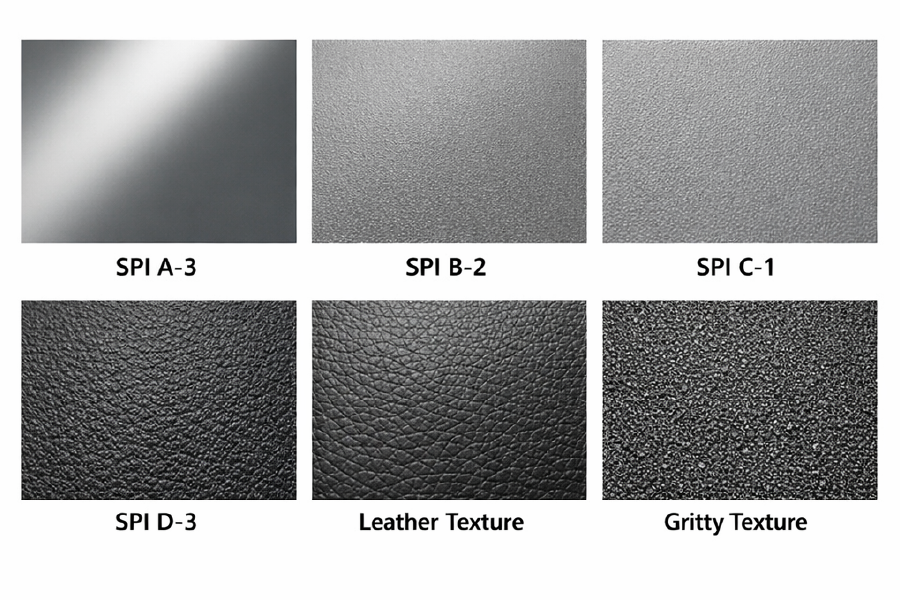
The Society of Plastics Industry is the most common surface finish system used in the United States for specifying injection mold surface finishes. There are four main categories within this system with three subgrades, based on the method and abraisves used.
SPI Surface Finish Grades
| SPI Grade | Polishing Method/Abrasive | Surface Roughness (RA µm) | Typical Appearance/Application |
|---|---|---|---|
|
A-1 |
6000 Grit Diamond Buff |
0.012-0.025 |
Mirror, Optical Clarity, and Transparent Parts |
|
A-2 |
3000 Grit Diamond Buff |
0.025-0.050 |
High-Gloss and Transparent Parts |
|
A-3 |
1200 Grit Diamond Buff |
0.050-0.100 |
High-To-Medium Polish and Non-Optical Lenses |
|
B-1 |
600 Grit Paper |
0.05-0.10 |
Medium Polish and General-Purpose |
|
B-2 |
400 Grit Paper |
0.10-0.15 |
Medium Polish |
|
B-3 |
320 Grit Paper |
0.28-0.32 |
Medium-Low Polish |
|
C-1 |
600 Grit Stone |
0.35-0.40 |
Low Polish and Dull Matte |
|
C-2 |
400 Grit Stone |
0.45-0.55 |
Low Polish |
|
C-3 |
320 Grit Stone |
0.63-0.70 |
Low Polish |
|
D-1 |
Dry Blast Glass Bead |
0.80-1.00 |
Satin Finish |
|
D-2 |
Dry Blast #240 Oxide |
1.00-2.80 |
Dull Finish |
|
D-3 |
Dry Blast #24 Oxide |
3.20-18.00 |
Dull and Coarse Finish |
Note:
- A Grades: High Gloss
- B Grades: Semi-Gloss
- C Grades: Matte
- D Grades: Texture
Verein Deutscher Ingenieure (VDI) 3400 Standard
The VDI standard (Society of German Engineers) is a common system internationally, especially in Europe and Asia. Electrical Discharge Machining primarily achieves VDI grades which specify matte and textured finishes with defined Ra values.
VDI 3400 Surface Finish Grades
| VDI Grade | Description/Process | Surface Roughness (Ra µm) | Approximate SPI Equivalent | Typical Appearance/Application |
|---|---|---|---|---|
|
VDI 12 |
600 Stone |
0.40 |
SPI C-1 |
Low Polish and Fine Matte |
|
VDI 15 |
400 Stone |
0.56 |
SPI C-2 |
Low Polish and Matte |
|
VDI 18 |
Dry Blast Glass Bead |
0.80 |
SPI D-1 |
Satin Finish |
|
VDI 21 |
Dry Blast #240 Oxide |
1.12 |
SPI D-2 |
Dull Finish |
|
VDI 24 |
Dry Blast #240 Oxide |
1.60 |
SPI D-2 |
Dull Finish |
|
VDI 27 |
Dry Blast #240 Oxide |
2.24 |
SPI D-2 |
Dull Finish |
|
VDI 30 |
Dry Blast #24 Oxide |
3.15 |
DPI D-3 |
Dull and Coarse Finish |
|
VDI 33 |
Dry Blast #24 Oxide |
4.50 |
DPI D-3 |
Dull and Coarse Finish |
|
VDI 36 |
Dry Blast #24 Oxide |
6.30 |
DPI D-3 |
Dull and Coarse Finish |
|
VDI 39 |
Dry Blast #24 Oxide |
9.00 |
DPI D-3 |
Dull and Coarse Finish |
|
VDI 42 |
Dry Blast #24 Oxide |
12.50 |
DPI D-3 |
Dull and Coarse Finish |
|
VDI 45 |
Dry Blast #24 Oxide |
18.00 |
SPI D-3 |
Dull and Coarse Finish |
Note: The lower VDI numbers mean finer, smoother finishes. Conversely, higher numbers mean coarser and more textured finishes.
Other Standards: Mold-Tech and Yick Sang
- Mold-Tech: Offers a large library of photo-chemically etched patterns, including leather, wood grain, geometric, and custom textures. Each pattern is assigned a serial number and a texture depth.
- Yick Sang: Trendy in Asia for custom and decorative textures, it is another catalog-based system.
Types and Categories of Injection Molded Surface Finishes
| Type of Finish | Appearance | How To | Application | Compatible Materials |
|---|---|---|---|---|
|
High-Gloss & Mirror Finish (SPO Grade A) |
Mirror-like, highly reflective, and optically clear. |
Diamond buffing with ultra-fine pastes (6000, 3000, and 1200 grit). |
Optical lenses, light covers, cosmetic housings, consumer electronics, and medical devices. |
Polycarbonate, acrylic, ABS, ABS/PC, and other hard, clear plastics. |
|
Semi-Gloss Finish (SPI Grade B) |
Smooth with a soft sheen, less reflective than mirror polish. |
Polishing with ultra-fine sandpaper (600, 400, and 320 grit) |
Automotive interiors, appliance housings, and consumer products. |
ABS, HDPE, nylon, PP, polycarbonate, and polystyrene. |
|
Matte Finish (SPI Grade C) |
Non-reflective, dull, and uniform matte. |
Polishing with fine-grit stones (600, 400, and 320 grit). |
Hides fingerprints, scratches, and minor molding defects. |
ABS, polypropylene, nylon, and HDPE. |
|
Textured and Bead-Blasted Finish (SPI Grade D) |
Uniform, non-directional matte, or satin to coarse texture. |
Bead Blasting (glass beads) or grit blasting (aluminum oxide). |
Consumer electronics, medical devices, soft-tough surfaces, and parts requiring grip or defect masking. |
ABS, polypropylene, HDPE, Nylon and TPU |
|
EDM Spark Erosion Textures (VDI 3400) |
Distinct, uniform, and non-directional matte or satin finish. |
Controlled spark erosion pits the mold surface, creating fine-to-coarse, non-directional textures. |
Parts needing enhanced grip, unique aesthetics, or masking of flow lines and weld marks. |
ABS, polycarbonate, polystyrene, and polypropylene. |
|
Chemical-Etched/Mold-Tech Textures |
Mold-Tech offers patterns such as leather, wood-grain, and geometric. |
Photo-chemical texturing (photo resist + UV + acid etching) enables intricate, repeatable patterns. |
Automotive dashboards, appliance panels, luxury goods, and ergonomic grips. |
ABS, polypropylene, polycarbonate, and TPU. |
|
Specialty and Custom Textures |
Grained, leather-like, wood-grain, geometric, and branded patterns. |
Laser engraving or chemical etching. |
Grips, soft-touch, and non-slip surfaces. |
ABS, polypropylene, HDPE, polystyrene, and nylons. |
|
As-Molded/Draft Finish |
Visible CNC tool marks and as-machined surface. |
A combination of fine blasting and polishing. |
Prototypes, internal components, and non-cosmetic parts. |
ABS, polypropylene, HDPE, and polystyrene. |
|
Satin Finish |
Smooth, low-gloss, and subtle sheen. |
A combination of fine blasting and polishing. |
Appliance housings, cosmetic packaging, and premium consumer products. |
ABS, polycarbonate, polypropylene, acrylic, and nylon. |
Processes and Techniques for Achieving Surface Finishes
- Hand Polishing: Progressive abrasives are applied manually. It is labor-intensive and creates matte to high-gloss finishes.
- Diamond Buffing: Diamond-impregnated tools and pastes. It achieves mirror-like finishes (SPI A) and is the highest cosmetic quality as well as the most costly.
- Stone Finishing: Abrasive stones create matte and satin finishes (SPI C). It can be a preparatory step.
- CNC “As-Machined:” Leaves visible tool paths and is suitable for non-cosmetic or internal parts.
- Bead or Grit Blasting: Propels fine beads or grit for uniform matte/satin or rough textures. It is fast and cost-effective.
- EDM Spark Erosion: Controlled electrical discharge pits the mold for efficient, uniform textures.
- Chemical and Photo-Chemical Etching: Photoresist + UV + acid etching. It offers intricate, repeatable patterns.
Factors That Affect Achievable Surface Finish Quality.
Draft Angles
- Textured or Rougher Finishes: Require more draft to ensure easier part ejection and prevent surface damage to the component.
- General Rule: Add 1.5° of a draft per 0.001″ (0.025 mm)
- Examples:
- Light bead-blast (PM-T1): 3° minimum
- Medium bead-blast (PM-T2): 5° minimum
- Mold-Tech MT-11010 (0.001 in depth): 1.5°
- Mold-Tech MT-11030 (0.002 in depth): 3°
Wall Thickness
- Uniform Wall Thickness: Makes consistent surface replication easier and reduces the risk of sink marks or flow lines.
- Thin Walls: The depth of texture will be limited.
Resin Type
- Non-Filled Resins: Pure resins and ABS replicate mold textures more faithfully.
- Glass and Mineral-Filled Resins: Gloss reduces with fillers and texture fidelity. Additives such as flame retardants can cause streaks or splay.
Mold Material
- Steel Molds: Support finer polishes and deeper textures.
- Aluminum Molds: Prone to wear, best for prototyping and low-volume runs.
Practical Considerations for Selecting a Surface Finish
Material Compatibility Table
| Finish Grade | Compatible Materials | Notes |
|---|---|---|
|
SPI A (Glossy) |
Acrylic, Polycarbonate, and PMMA. |
Best for optically clear/high-gloss parts. |
|
SPI B (Semi-Gloss) |
ABS, HDPE, Nylon, Polypropylene, and Polystyrene. |
Good for general-purpose parts. |
|
SPI C (Matte) |
ABS, HDPE, Nylon, Polypropylene, and Polystyrene. |
Hides tool marks and minor defects. |
|
SPI D (Textured) |
ABS, HDPE, Nylon, Polypropylene, Polystyrene, and TPU. |
Improves grip and hides defects. Avoid polycarbonate. |
Cost Implications
- SPI A (High-Gloss): Extensive diamond polishing. High mold cost and lead time.
- Textured Finishes (Mold-Tech, VDI, SPI D): Involves bead blasting or chemical etching. It adds and may require more drafts.
- SPI B and C: Less expensive due to requiring less intensive polishing.
- Finish Cost: One-time tooling expense. It does not affect the per-part cost.
Functional vs Aesthetic Considerations
- High-Gloss: Optical clarity and premium appearance.
- Matte or Textured: Hide weld lines, flow marks, and fingerprints for improved quality.
- Textured: Enhance grips, reduce friction, or improve paint adhesion.
- UV-Resistant Materials: Pair with finishes that do not degrade under sunlight for outside applications.
- Durability: Surface finishes improve resistance to scratches and scuffs.
Design
- Specify Finish Locations: Clearly show on drawings and CAD models.
- Features: Minimum of 0.015 in (0.38 mm) in height for masking and texturing.
- Consider: Ejection pins and gate locations for cosmetic surfaces.
- Finishes: Deep ribs and thin features are challenging.
Application by Industry
| Industry | Typical Finishes | Applications |
|---|---|---|
|
Textured (SPI D and Mold-Tech), Matte (SPI C) |
Dashboards, steering wheels, and interior trim. |
|
|
High-Gloss (SPI A) and Semi-Gloss (SPI B) |
Device housings, display covers, and buttons. |
|
|
Matte (SPI C) and Textured (SPI D) |
Housings, grips, handles, and diagnostic equipment. |
|
|
Matte (SPI C) and Semi-Gloss (SPI B) |
Caps, closures, and containers. |
|
|
Textured (SPI D and Mold-Tech) |
Power tool housings, grips, and shop vacs. |
FAQs
Define: Injection Molding
Injection molding is a manufacturing process used to create parts by injecting molten material into a mold. It is commonly used for producing plastic, metal, and other composite parts with high precision and repeatability.
What are common injection molding materials?
Common injection molding materials include:
- Polypropylene (PP)
- Acrylonitrile Butadiene Styrene (ABS)
- Polycarbonate (PC)
- Nylon (PA)
- Polyethylene (PE)
- Polystyrene (PS)
- Thermoplastic Elastomers (TPE)
What kinds of finishes are there for injection-molded components?
Injection-molded components can have a variety of finishes, including:
- Glossy
- Matte
- Textured
- Painted
- Plated
- Anodized
- Silk-screened
- Laser-etched
How to indicate what the surface finish should be for your injection-molded project?
Specify the desired surface finish using industry-standard terms such as “smooth,” “textured,” or “matte.” Provide details on the required Ra (roughness average) value, if applicable. Indicate any specific finish treatments, like polishing or bead blasting, that are needed.