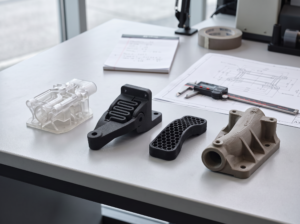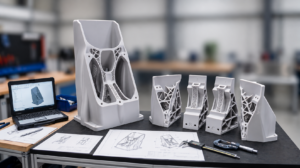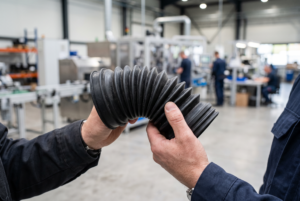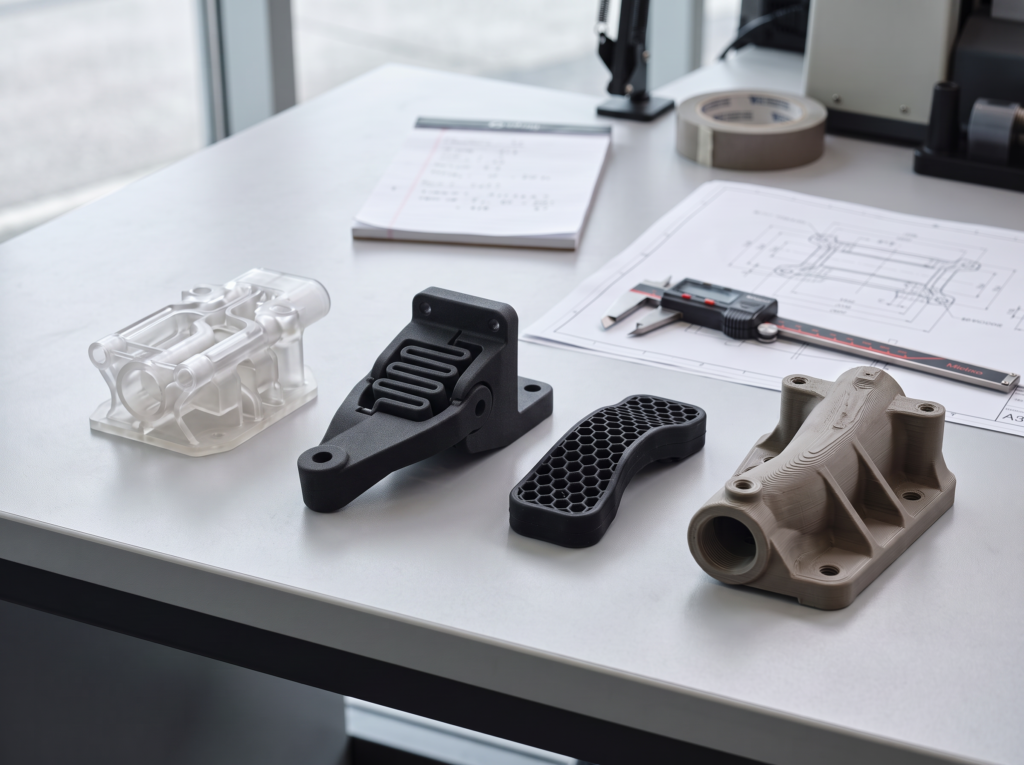
Manufacturing process selection for 3D printing can look like a technology question, but several additive methods may be capable of producing the same geometry. The practical differences often show up elsewhere: material behavior, critical features, surface condition, quantity, secondary operations, cost, quality requirements, and delivery.
That makes the finished part a useful starting point when choosing a 3D printing process. What does it need to do? Which requirements are fixed, which are flexible, and what condition must the component be in when it reaches the next stage of the project?
Manufacturing Process Selection Starts With the Finished Part
Function is usually the first filter. A fit-check prototype and an end-use component may share the same geometry while carrying very different requirements for material behavior, tolerances, durability, surface condition, or inspection.
Material requirements can narrow the available additive manufacturing processes quickly. Part size, geometry, wall thickness, feature detail, critical interfaces, and the need for flexibility, stiffness, or other application-specific behavior can narrow them further.
The expected delivery state matters as well. Some components require little beyond the additive build. Others may still need machining, inserts, finishing, assembly, inspection, or another secondary operation before they are ready to use.
Those details can affect 3D printing process selection in subtle ways. A critical hole or mating surface, for example, may be easier to control through a secondary operation than by selecting the entire additive process around that one feature. A cosmetic requirement can make orientation and finishing just as important as the build itself.
Cost and Lead Time Are Part of Process Fit
Cost and lead time are closely tied to the technical requirements. Print time alone does not determine delivery, and build price alone does not determine total project cost.
One manufacturing route may carry a higher build cost but require relatively little downstream work. Another may be less expensive at the build stage and still be the more practical choice if finishing, machining, inspection, or assembly are limited. The balance depends on the part and the required delivery condition.
Lead time can shift in the same way. Build scheduling, support removal, curing or cleaning, finishing, secondary machining, inspection, and assembly can all contribute to the elapsed time between a released design and a finished component.
Quantity changes the economics again. Nesting or batch efficiency, material utilization, manual finishing, inspection effort, and handling can matter differently for a few development parts than they do for a recurring requirement. An additive manufacturing process that fits the first build may deserve another look as quantities or production expectations change.
Comparing the complete manufacturing path usually provides a clearer picture than comparing print price or machine time by itself.
Additive Processes at a Glance
| Process | Common Strengths |
|---|---|
| Selective Laser Sintering (SLS) | Support-free complex geometries; functional nylon and specialty materials; strong mechanical performance. |
| Multi-Jet Fusion (MJF) | Functional nylon parts; support-free builds; high-density parts and fine feature resolution. |
| Stereolithography (SLA) | High-resolution detail; large models and prototypes; broad resin options. |
| Digital Light Processing (DLP) | Smooth surfaces; high detail and dimensional accuracy; diverse resin options. |
| Hybrid PhotoSynthesis (HPS) | High detail and surface quality; isotropic mechanical properties; part consolidation. |
| Fused Filament Fabrication (FFF) | High-performance thermoplastics; large build capacity; cost-efficient prototyping. |
| Material Jetting | Complex geometries; multiple-material printing; high-detail visual and prototype parts. |
Use the Requirements to Narrow the Options
Once the application requirements are visible, process families begin to separate naturally. A functional nylon component may bring SLS or MJF into the discussion. A detailed resin part with demanding feature or surface requirements may bring SLA or DLP into consideration. Larger geometry, flexible behavior, material preference, quantity, or finishing requirements can shift the evaluation again.
These examples are starting points rather than fixed rules. Two parts that look similar can justify different manufacturing choices because of how they will be used, which features are critical, and what needs to happen after printing.
In some cases, several additive processes remain technically viable. The useful comparison then moves to the tradeoffs among material performance, surface condition, tolerance strategy, downstream work, quantity, cost, quality requirements, and schedule.
Evaluate the Whole Manufacturing Path
Effective additive manufacturing process selection also accounts for what happens after the build. Orientation and support strategy can affect surfaces and downstream work. Critical holes, threads, or mating features may be handled through secondary machining. Cosmetic requirements may add finishing steps. Hardware or assembly can influence how the part is built in the first place.
Inspection requirements can add another layer. A dimension that is important to function may affect orientation, feature strategy, or the decision to finish a surface after printing. Those relationships are easier to account for when they are identified before the process is fixed.
Quality and program requirements can narrow the path further. Inspection plans, traceability, documentation, and customer-specific reporting may need to be built into the manufacturing workflow rather than added at the end. For regulated programs, supplier qualifications such as AS9100D, or cybersecurity requirements such as CMMC Level 2, may also be part of the sourcing criteria. Prototek certification and quality information can be reviewed alongside the technical requirements for the project.
Future requirements matter too. If the current need is a prototype, the manufacturing path may change as the design stabilizes, quantities increase, or inspection and documentation requirements become more formal. That is one reason it can be useful to consider recurring production while the project is still in development.
Manufacturing Evaluation Benefits From Context
A CAD model provides the geometry, but choosing an additive manufacturing process usually depends on more context: application requirements, critical features, material needs, quantity, budget, schedule, delivery condition, quality or documentation requirements, and any expected secondary operations.
With those inputs available, build orientation, post-processing, machining, finishing, inspection, and assembly can be considered together rather than one step at a time. The resulting process choice may confirm the approach originally requested, or it may reveal a different material, additive process, or secondary operation that better fits the requirement.
Prototek’s additive team works through these variables with customers when a project has more than one viable manufacturing route. The discussion stays grounded in the part itself and in the practical requirements that determine how it needs to be delivered.
Frequently Asked Questions
What factors affect 3D printing process selection?
3D printing process selection commonly considers function, geometry, material behavior, tolerances, surface requirements, size, quantity, cost, lead time, finishing,