Until recently, laser welding was not as popular as Arc, MIG, and TIG welding. The machines were large and very expensive. In the last 25 years, advancements in fiber laser technologies and the introduction of handheld systems have increased the popularity of fiber laser technology. Offering precision and speed, it creates narrow, deep welds with minimal heat input.
In this blog post, we’ll discuss what it is and how it works, its history, types of laser welds, and ideal materials for this welding process.
What is laser welding?
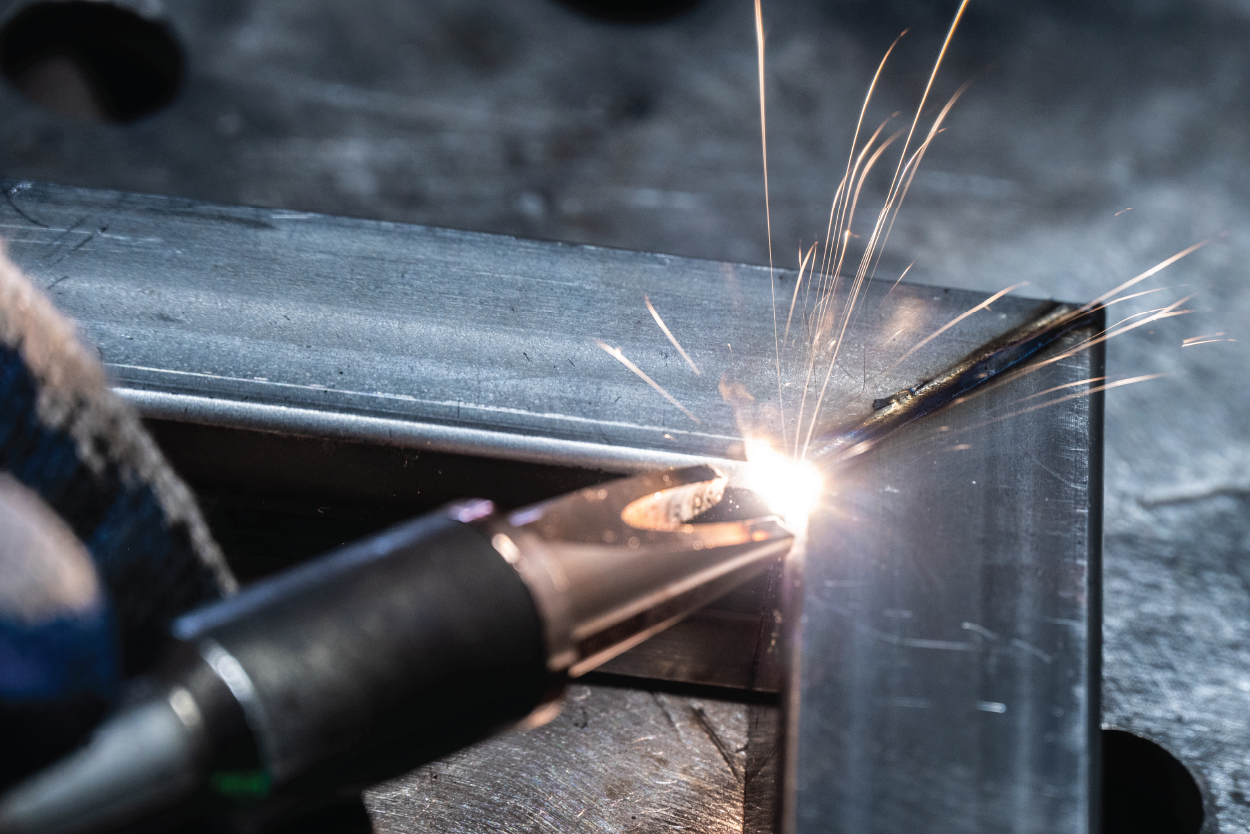
Laser welding is a process that focuses a laser beam to melt and fuse metal and certain plastics with precision and speed. With minimal heat input, it creates narrow, deep welds with less distortion and smaller heat-affected zones compared to more traditional welding methods. Automation ensures consistent quality across many components and is similar to spot welding. The use of a filler metal can strengthen the bonding power. This welding process is an excellent choice for high-volume production and is a standard in many industries, including automotive, aerospace, medical, and electronics.
What is the history of laser welding?
Albert Einstein laid out the theory for lasers in 1917 when he introduced the concept of stimulated emission. During the 1960s, Theodore Maiman, an American engineer and physicist, built the first operational laser. Leading to the 1962 first ruby laser welding machine experiments on steel and titanium by the American Optical Company.
The 1970s began with the Western Electric Company introducing CO₂ lasers. Following this development, they produced the first commercial laser welding machines. During the 1980s, the first viable fiber lasers were available, offering a better laser beam quality and efficiency.
The 1990s – 2000s saw the creation of more types of lasers, including disk, diode, ultrafast, and hybrid lasers. With these advancements, the range of applications of laser welding grew substantially. Since the 2010s, real-time monitoring has been introduced, along with portable systems, AI and robotics integration, and new wavelengths, including blue lasers for copper. This technology is continuing to evolve today.
How does laser welding work?
Several steps need to take place for successful laser welds.
Prepwork
The surfaces need to be clean before welding. Meaning the surfaces are free of contaminants such as dirt, rust, paint, or any other particles that can mess up the weld. Next, positioning the pieces together is very important because laser welding is less forgiving of gaps and misalignment than traditional welding methods. Clamp the pieces in place for assured stability during the welding process.
Laser Beam Delivery
Generate the laser beam via a source like CO₂, ND:YAG (solid-state), fiber laser, or a disk laser. The type of laser will depend heavily on the material and application. Once the laser starts, mirrors, lenses, or fiber optics deliver it in a focused beam to a precise spot at the joint.
Focusing and Energy Application
Using the optical components listed above, the laser beam will achieve the necessary energy density to melt the material. The material’s properties and thickness will determine the laser’s power and focus.
Melting and Fusion
The laser beam rapidly heats the material at the joint where it is focused, creating a molten pool. Due to the high energy density, it allows for deep, narrow welds with minimal heat-affected zones. The laser is moved along the joint, producing the weld. As the laser moves away from the molten pool, it cools and solidifies, fusing the materials.
Shielding Gas
Using argon, helium, or other inert gases is a standard way to shield the weld area from oxidation and contamination; the use of gas is essential for reactive materials.
Cooling and Inspection
Once the molten pool solidifies, this is called the weld. It undergoes inspection for defects like cracks, incomplete fusion, or porosity. For real-time quality assurance, automated monitoring systems aid in the inspection process.
Types of Laser Welding
There are two modes of laser welding methods, including conduction welding and keyhole welding.
Conduction Mode Welding:
In this mode of laser welding, the laser beam slowly vaporizes the surface of the metal as the laser moves on the pieces, cools, and solidifies, creating the weld. Conduction welding creates narrow, wide welds with high-quality, aesthetically pleasing results.
This technique is an outstanding choice for projects that require aesthetically pleasing surface finishes or thin materials.
Keyhole (Deep Penetration) Welding:
This method uses a high-power laser to vaporize the material. It is a fast, aggressive approach that penetrates deeper into the material, reducing it to a gaseous state, creating deep, narrow welds.
Keyhole welding is ideal for projects that require thicker materials and high-volume production because of its speed.
What types of laser welds are there?
There are various types of laser welders, with the most common being fiber lasers. Other lasers include blue/green lasers, CO₂ lasers, Nd:YAG lasers, and diode lasers.
Fiber Laser Welding
As the most common type of laser welding, it is contact-free, using highly focused laser beams as the heat source. There are several advantages to this welding method, including high speed, minimal heat input, and precision, making it an exemplary choice for a variety of applications. Fiber lasers are known for efficiency, low maintenance requirements, and high-quality welds with minimal distortion.
Typical applications for fiber laser welding include automotive (body panels, chassis components, and other parts), aerospace (aircraft components, turbine blades, and engine parts), medical and healthcare (medical devices and implants), and electronics (circuit boards, sensors, and connectors).
CO₂ Laser Welding
CO₂ laser welding uses a high-energy CO₂ laser beam to fuse materials, creating a strong, exact weld. This technique is known for its ability to weld diverse materials such as fabrics, plastics, and metals. It is also energy efficiency and speed. Nonetheless, they are less efficient with reflective materials that require mirror-based delivery.
Typical applications of CO₂ laser welds include automotive (body panels, chassis parts, and exhaust systems), aerospace (fuselage sections, engine components, and other aircraft parts), electronics (metal housings), and medical and healthcare (surgical instruments and implants).
Nd:YAG Laser Welding
This type of laser welding uses a neodymium-doped yttrium aluminum garnet laser as its light source. It is an outstanding choice for precision welding applications such as microelectronics and medical devices.
Typical applications of Nd:YAG laser welds include automotive (tailored blanks, transmission components, and welded hems), medical and healthcare (implants, surgical instruments, and catheters), and electronics (connectors and battery components).
Blue/Green Laser Welding
Metals like copper and its alloys use blue and green lasers due to their high absorption rates compared to more traditional lasers like infrared. Blue lasers offer advantages in welding thin materials and metals with high reflectivity, while green lasers are visible and sustainable when low-intensity lasers are necessary for projects.
Typical applications of blue/green laser welds include automotive (solenoids, fuel injectors, and engine components) and electronics (copper parts and battery components).
Diode Laser Welding
Common for conduction mode welding, this form of laser welding is excellent for joining thin metals and tiny components. Diode laser welders are known for their compact size and are ideal for applications that require precision and flexibility.
Typical applications for diode laser welds include automotive (chassis and battery components), aerospace (engine components and structural parts), medical and healthcare (diagnostic equipment), electronics (consumer electronics like phones and TVs as well as semiconductors).
Benefits of Laser Welding
- High Precision and Control – Offering exceptional precision, it is ideal for intricate geometries, and the focused beam gives excellent control over the weld area.
- Minimal Heat-Affected Zone – Concentrating the energy input means the heat-affected zone is minuscule compared to traditional welding methods. Meaning the components will have minimal distortion, residual stresses, and unwanted changes in the material properties.
- High Productivity and Welding Speed – The high speeds significantly improve the throughput and reduce cycle times, which is beneficial with high-volume production.
- Deep and Narrow Welds – In a single pass, deep narrow welds are achievable, which means strong joints and minimal filler material.
- Automation and Flexibility – With easy integration into automated systems and robotics, it allows for high repeatability and consistency for a variety of materials and joint configurations.
- Clean and Aesthetic Joints – There is minimal post-processing and finishing necessary.
Challenges of Laser Welding
- Precise Alignment of Joint – Gaps and misalignments can result in weak welds.
- Material Limitations – It is suitable for many metals and some plastics. Highly reflective metals can be a challenge and may require a specific type of laser.
- Safety Concerns – Strict safety measures need to be implemented, including training, shielding, and proper safety equipment.
- Limited Thickness Range – It is most effective for thin to medium-thick materials. Thicker materials may require multiple passes or hybrid processes.
- Sensitivity to Contaminants – Oil, rust, or coatings can interfere with laser absorption and weld quality.
Conclusion
A substantial technology in precision joining technologies, laser welding, offers numerous advantages such as high speed, minimal distortion, and fantastic weld quality. As the technology advances, laser welding will become even more accessible and prevalent. Understanding how it works, the types of lasers, and the benefits and challenges, engineers and project managers can make more informed decisions about what their project requires.
FAQs
It is a precise and efficient joining process that uses a concentrated beam of light to fuse materials.
It can join a variety of metals, including steel, aluminum, titanium, and stainless steel, as well as nonmetals such as ceramics, composites, and plastics.
The aerospace, automotive, and electronics industries commonly employ this precise welding process.