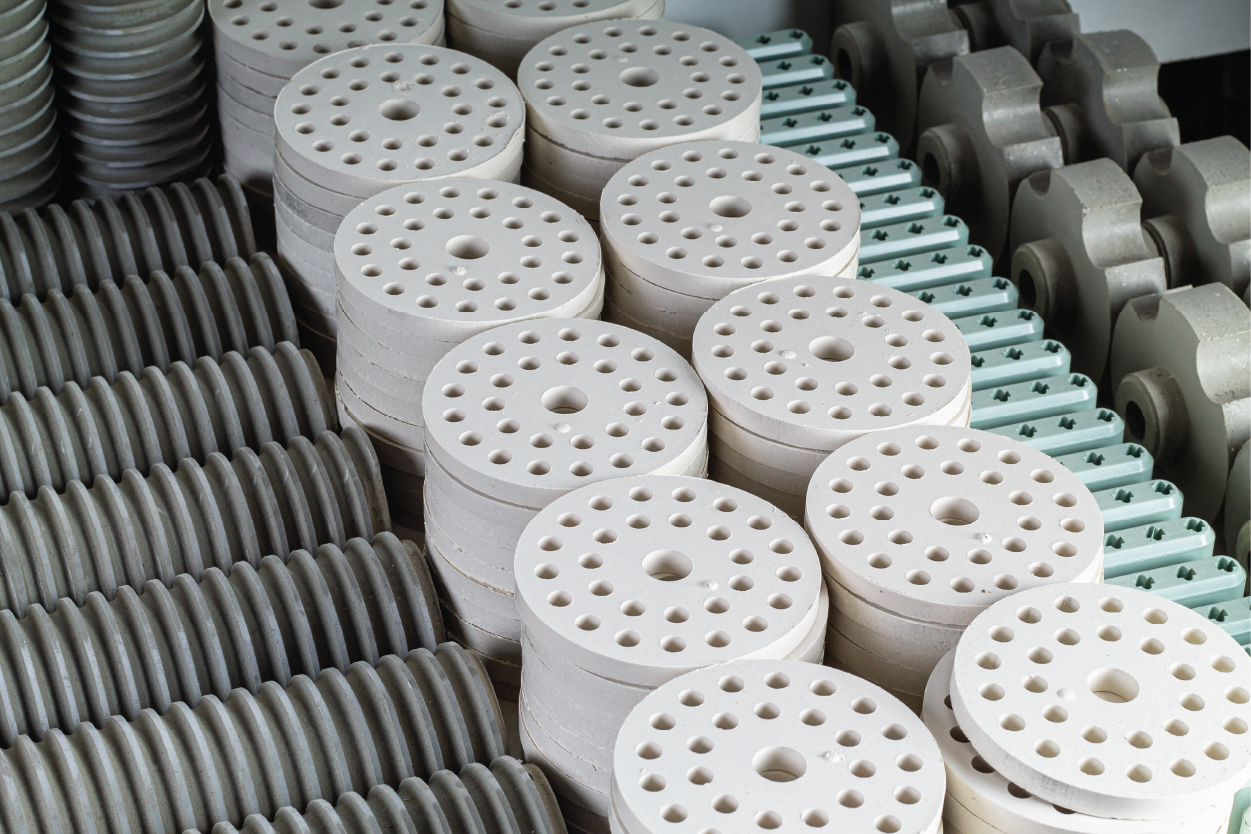
Macor is a unique machinable glass-ceramic material that Corning Glass Works developed with Dr. George Beal. It combines the high-performance properties of technical ceramics and the ease of machining offered by metals and plastics. It is a versatile, precise, and reliable ceramic commonly found in aerospace, electronics, medical, and scientific industries. Traditional ceramics are difficult to machine, making tight tolerances almost always unachievable–this is where Macor really shines.
In this blog post, we’ll discuss what Macor is, its history, how it’s made, and its mechanical properties.
What is Macor?
Macor is a glass-ceramic material known for its unique combination of the two groups’ properties, such as high strength, thermal and electrical insulation, and radiation resistance. Due to its machinability, complex shapes and precision components with tight tolerances are routine. Cutting Macor with conventional metalworking tools, unlike other technical ceramics, which means there are faster turnaround times and lower costs associated with machined Macor.
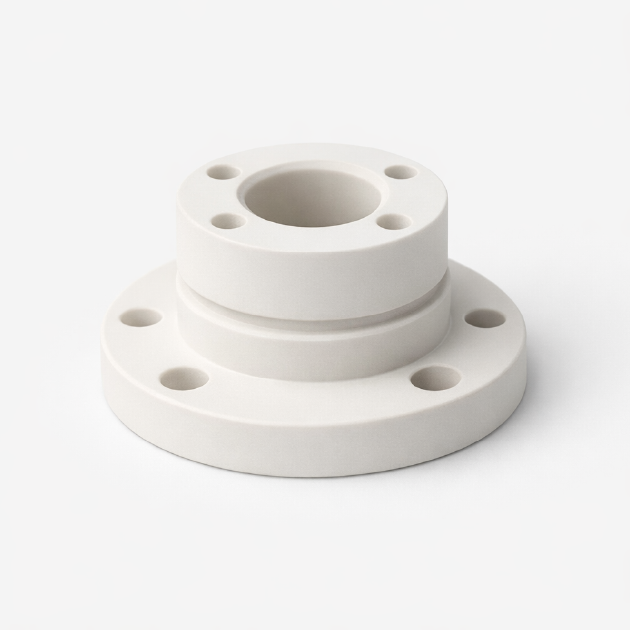
It’s an excellent choice for prototyping and low to medium-volume production runs. Macor’s composition is roughly 55% fluorphlogopite mica and 45% borosilicate glass, and its appearance is opaque white – very similar to porcelain. It can have operating temperatures continuously at 800° C (1,472° F) and with occasional brief spikes of up to 1,000° C (1,832° F).
What is the history of Macor, and how is it made?
The invention and trademark of Macor in the 1950s by Corning Incorporated was for its unique properties as a high-performance electrical insulator. It quickly became suitable for a variety of applications due to these properties.
The production of Macor starts with melting and casting the raw materials using conventional glassmaking techniques. The result is flourine-rich glass that separates into droplets when cooled. Subsequently, a heat treatment of the droplets allows for crystallization, forming random interlocking mica crystals within a borosilicate glass matrix. This unique microstructure is what’s known as Macor.
After Macor goes through the steps of melting and casting raw materials, phase separation, and controlled heat treatment, the sheets and blanks are ready to be machined into their final components. Finalizing these components can be done by precision machining, such as drilling, grinding with high-speed steel or carbide tools, milling, or turning.
What are the mechanical properties of Macor?
Macor is known for several properties:
- Chemical Resistance – great for harsh environments.
- High Electrical Insulation – avoiding electrical hazards and facilitating success in demanding environments.
- Highly Polishable – ease of finishing.
- Highly Solderable – to a large variety of materials.
- High Strength and Stiffness – allowing for structural integrity and load-bearing applications.
- High Thermal Insulation is excellent for dimensional stability and preventing heat transfer.
- High Temperature Stability – also helps with dimensional stability and harsh environments.
- Lead Free – suitable for health and toxicity concerns.
- Machinability – excellent for precision and tight tolerances.
- Radiation Resistant – structural integrity in nuclear, aerospace, and defense environments where radiation is present.
- Zero Porosity and No Outgassing – significant for high-vacuum environments.
Here are the main mechanical properties of Macor (According to AZO Materials):
| Property | Imperial Min | Imperial Max | Metric Min | Metric Max |
|---|---|---|---|---|
|
Atomic Volume (average) |
549.213 in3/kmol |
579.725 in3/kmol |
0.009 m3/kmol |
0.0095 m3/kmol |
|
Density |
155.446 lb/ft3 |
158.567 lb/ft3 |
2.49 Mg/m3 |
2.54 Mg/m3 |
|
Energy Content |
2166.77 kcal/lb |
2708.47 kcal/lb |
20 MJ/kg |
25 MJ/kg |
|
Bulk Modulus |
7.5231 106 psi |
7.90455 106 psi |
51.87 GPa |
54.5 GPa |
|
Compressive Strength |
47.6449 ksi |
52.5327 ksi |
328.5 MPa |
362.2 MPa |
|
Ductility |
0 |
0 |
0 |
0 |
|
Elastic Limit |
4.77174 ksi |
5.25037 ksi |
32.9 MPa |
36.2 MPa |
|
Endurance Limit |
4.51792 ksi |
4.99219 ksi |
31.15 MPa |
34.42 MPa |
|
Fracture Toughness |
1.32867 ksi.in1/2 |
1.45607 ksi.in1/2 |
1.46 MPa.m1/2 |
1.6 MPa.m1/2 |
|
Hardness |
195.801 ksi |
609.159 ksi |
1350 MPa |
4200 MPa |
|
Loss Coefficient |
5e-005 |
0.0002 |
5e-005 |
0.0002 |
|
Modulus of Rupture |
12.9809 ksi |
15.229 ksi |
89.5 MPa |
105 MPa |
|
Poisson’s Ratio |
0.28 |
0.29 |
0.28 |
0.29 |
|
Shear Modulus |
3.6738 106 psi |
3.858 106 psi |
25.33 GPa |
26.6 GPA |
|
Tensile Strength |
4.77174 ksi |
5.25037 ksi |
32.9 MPa |
36.2 MPa |
|
Young’s Modulus |
9.47096 106 psi |
9.95974 106 psi |
65.3 GPa |
68.67 GPa |
|
Glass Temperature |
2114.33° F |
2600.33° F |
1430 K |
1700 K |
|
Latent Heat of Fusion |
– |
– |
– |
– |
|
Maximum Service Temperature |
1471.73° F |
1831.73° F |
1073 K |
1273 K |
|
Melting Point |
– |
– |
– |
– |
|
Minimum Service Temperature |
-459.67° F |
– |
0 K |
– |
|
Specific Heat |
0.598966 BTU/lb.F |
0.622956 BTU/lb.F |
774 J/kg.K |
805 J/kg.K |
|
Thermal Conductivity |
2.62085 BTU.ft/h.ft2.F |
2.92037 BTU.ft/h.ft2.F |
1.4 W/m.K |
1.56 W/m.K |
|
Thermal Expansion |
22.86 10-6/°F |
23.76 10-6/°F |
12.7 10-6/K |
13.2 10-6/K |
|
Breakdown Potential |
975.36 V/mil |
1056.64 V/mil |
38.4 MV/m |
41.6 MV/m |
|
Dielectric Constant |
5.6 |
6.1 |
5.6 |
6.1 |
|
Resistivity |
1e+022 10-8 ohm.m |
1e+024 10-8 ohm.m |
1e+022 10-8 ohm.m |
1e+024 10-8 ohm.m |
Which industries use the material?
Macor is an exceptional engineering ceramic with wide-ranging applications in various industries.
Aerospace and Defense Industry
Aircraft engines, spacecraft components, and missile systems, electrical sensor housings, and precision coil formers use Macor due to its high-temperature insulation, electrical insulation, dimensional stability, and thermal shock resistance, allowing for rapid cooling and heating cycles without cracking. Macor components also benefit from dimensional stability and vacuum environments, allowing them to withstand the pressure of high-altitude flight.
Automotive Industry
Components like sensors that measure oxygen, temperature, and pressure in the engine, exhaust systems, and ignition systems use Macor due to its high-temperature resistance, electrical insulation qualities, and thermal stability.
Electrical Industry
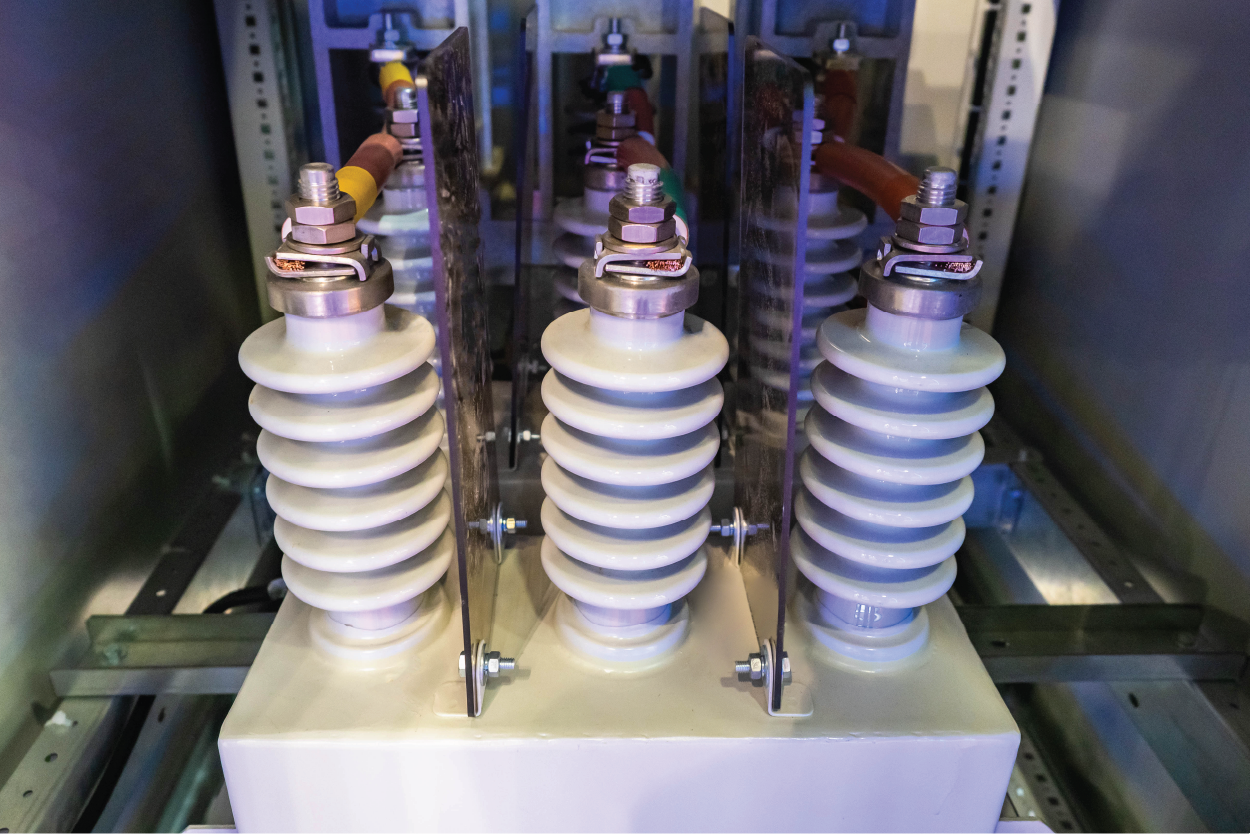
Components such as high voltage insulators, precision coil formers and insulators, circuit boards, sensor housings, and vacuum tubes use Macor due to its excellent insulation capabilities, low thermal expansion coefficient, and high thermal stability.
Energy and Industrial Industries
Reference blocks and fixtures in power generation units of nuclear plants, insulators, coil formers, welding nozzles, fixtures, along with chemical processing valves, seals, and reactor components, all use Macor for its unique qualities.
Medical and Healthcare Industries
Components such as surgical instruments and devices, dental implants, medical imaging systems, and laboratory equipment all use Macor due to its low porosity, biocompatibility, sterilization, and radiation resistance.
FAQs
What is Macor?
It is a machinable glass-ceramic material renowned for its exceptional thermal, electrical, and mechanical properties, making it an ideal choice for various industrial applications.
What industries use Macor?
Due to its exceptional thermal and mechanical properties, it is a machinable glass-ceramic material widely used in the electronics, aerospace, and medical device industries.
What are suitable applications for Macor?
Applications demanding high thermal and mechanical stability can use this material. Some examples are semiconductor equipment, medical devices, and aerospace components.
What finishes are there for Macore?
Finishing components made from this material using various methods, such as polishing, grinding, and precision machining, to achieve a high-quality surface.